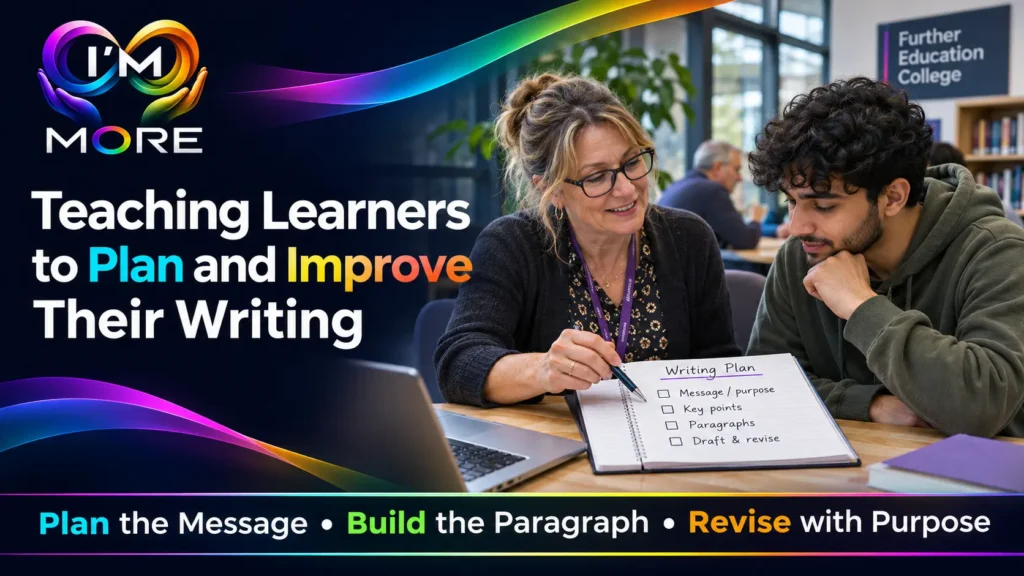
A learner may understand a topic and still struggle to put that understanding into writing. They might have several relevant ideas but no clear way to arrange them. Another learner may produce a long response that never explains its central point. Telling either person to add detail leaves the difficult decisions unexplained.
Teaching writing means making those decisions visible. Learners need to understand the purpose of a piece, select relevant content and connect ideas so that a reader can follow them. They also need opportunities to revise with a clear reason for each change. These are teachable processes that belong within subject lessons as well as English classes.
For teachers supporting young adults, writing instruction should be respectful of age and responsive to starting points. A short, clear task can be demanding without looking childish. At IM MORE, Discover, Believe, Become can connect existing knowledge, visible improvement and more independent communication.
Start with the reader and purpose
Explain what the writing needs to achieve. Is the learner describing a process, recommending an option, comparing evidence or explaining a cause? Each purpose requires different choices. A process description needs a clear sequence, while a recommendation needs reasons connected to the reader’s requirements.
Provide a realistic audience where useful. Asking learners to recommend one of two fictional study spaces for a particular person creates a reason to select some details and leave others out. Supply the information about both spaces and the person’s needs, so learners are not dependent on personal experience.
Keep the initial task manageable. One carefully developed paragraph can reveal more about an explanation than a page of loosely connected sentences. Increase the scope as learners become more secure in the decisions involved.
Check the ideas before expecting a draft
Ask learners to explain the central idea orally, arrange a few notes or select relevant information from a short text. This can reveal whether the difficulty begins with subject knowledge or with expressing knowledge in writing. A learner cannot reliably explain a relationship they have not yet understood.
Teach any missing content before continuing. Where learners have the knowledge, help them choose a main point and supporting information. Do not treat every unfinished paragraph as a problem of motivation or effort; first examine what the learner is being asked to coordinate.
The Education Endowment Foundation’s secondary literacy guidance offers further reading on writing across subjects. For adult provision, consider how the subject focus relates to the actual writing demands of the course and to learners’ access needs.
Study a short model
Show an example of the kind of writing learners will attempt. Select one feature to examine, such as a sentence explaining how evidence supports a claim. Ask what that sentence adds and where the explanation would become incomplete without it.
Avoid presenting a model that contains more decisions than learners can study at once. A short paragraph makes an important connection easier to locate. Compare it with a version that omits the feature, then explain why the difference matters for the reader.
A model should support understanding rather than become a template copied mechanically. Change the content in the practice task so learners must apply the decision themselves. Keep the underlying writing purpose consistent enough for the connection to remain clear.
Demonstrate the movement from notes to sentences
Think aloud while turning a few notes into connected writing. Explain why one idea comes first, where the evidence belongs and which information can be left out. Show a small revision when a first sentence does not express the connection clearly.
Keep the demonstration focused. Learners do not need commentary on every minor word choice at the same time. If the lesson concerns explaining evidence, draw attention to the words that connect the evidence with the point. Other editing decisions can receive attention later.
Invite a prediction at one decision point. Learners might choose which note should come next or identify the sentence that needs further explanation. Use their responses to check whether the process is becoming clearer before expecting independent writing.
Choose a proportionate planning method
Offer a structure that serves the task. A short explanation might use notes about the point, evidence and connection. A comparison might need space for information about both items. A process description may be clearer when the stages are arranged before drafting begins.
Explain that a plan is a working resource. Learners can change it when drafting reveals an unnecessary detail or a missing idea. Avoid requiring an elaborate planning sheet for every brief response. Planning should make the writing easier to produce and review.
Some learners may need a partially completed structure at first. Others may be ready to choose their own. Observe whether the support helps them make relevant decisions, and reduce prompts when they can carry out those decisions more independently.
Provide supported and independent practice
Build a short paragraph together after the demonstration. Ask learners to propose content and explain where it belongs. Compare two possible sentences and discuss which one communicates the intended relationship more clearly. Pause for individual thinking so participation extends beyond a few confident contributors.
Then give learners a fresh task with the same writing purpose. Protect enough time for an independent attempt. A lesson filled with examples and discussion can leave little opportunity to see what learners can actually produce themselves.
Note the support used when interpreting the work. A paragraph completed with extensive prompting gives different information from one produced independently. Both can show progress, but they should guide different next steps.
Teach revision with a reason
Ask learners to examine whether the writing achieves its purpose. Can they locate the main point? Does the evidence fit? Which sentence explains the connection? Model a revision that improves communication, such as replacing a vague reference with the precise idea being discussed.
Address spelling, punctuation and other editing needs as well, while distinguishing them from developing the message. Both matter for readable writing. Choose priorities that learners can act on without losing sight of the main learning goal.
Give time to make the change and explain its effect. A comment becomes more useful when a learner can turn it into an action. Avoid requiring a full rewrite when revising one sentence would provide a focused learning opportunity.
Practise a sentence decision separately
Sometimes learners need a small opportunity to practise one writing decision before coordinating a whole paragraph. Give two related ideas and ask learners to connect them so the relationship is accurate. Discuss how different word choices can change the meaning.
For example, one sentence might state that a room has adjustable lighting and another that a fictional learner needs to reduce glare. Ask learners to explain the relationship without adding unsupported details. Compare responses for clarity and accuracy rather than rewarding the longest sentence.
Return the decision to the larger task afterwards. A sentence exercise should help learners communicate within a meaningful piece of writing. Ask them to locate where the same relationship belongs in their own paragraph, and provide a chance to apply it.
Help learners identify where they became stuck
Invite learners to name the point at which writing became difficult. Did they lack information, struggle to choose a point or have trouble expressing the connection? Offer a small set of concrete prompts when a general reflection question feels too broad.
Match the response to the difficulty. Missing knowledge needs teaching or an appropriate source. An unclear plan may need reordering. A sentence that obscures meaning may need a model or oral rehearsal. A general instruction to keep trying cannot replace these different forms of support.
Check whether the chosen action helped. Over time, learners can begin to select a suitable strategy themselves. Teach that selection within real subject tasks instead of expecting a general study technique to transfer automatically.
Keep feedback and assessment aligned
Explain which criteria apply to the task and use them consistently. A practice paragraph may focus on one part of an explanation, while a formal assessment may require several features. Make the difference clear before learners begin.
Do not let attractive vocabulary distract from inaccurate subject content. Equally, recognise an accurate explanation even when the learner still needs help with written presentation. Distinguishing the strengths and needs gives both teacher and learner a more useful next step.
Where formal qualifications are involved, follow the relevant assessment requirements and the setting’s arrangements. Classroom practice should prepare learners for those demands through explicit instruction and suitable opportunities to improve.
Make improvement visible
Invite learners to compare the first and revised versions. Ask which change helped the reader and why. Feedback such as “Your evidence now connects clearly to the recommendation” identifies something the learner can repeat in a future task.
During Discover, recognise an idea the learner can already explain. During Believe, point to a specific improvement. During Become, ask them to use the same writing decision in a different context with less prompting. Confidence can grow alongside evidence of an achievable skill.
For the next writing lesson, choose one decision to teach, a short model and a realistic independent task. Plan time for revision before the session ends. Learners need opportunities to experience writing as a process they can understand, practise and improve.
Where previous setbacks have affected confidence, IM MORE’s article on unemployment and self-worth offers related reading for a separate conversation about personal value.