

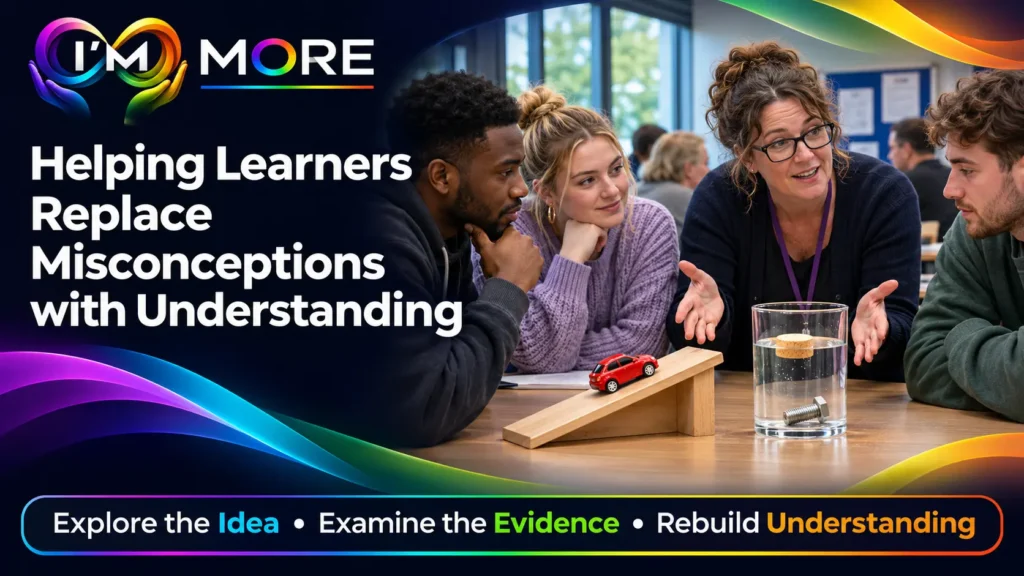
Addressing Learner Misconceptions
A wrong answer can reveal more than a missed detail. Sometimes a learner is applying a rule that seems sensible but does not fit the subject. They may assume that a fraction with a larger denominator always represents a larger amount, or that a longer written answer must contain a stronger explanation. Supplying the correct answer alone may leave the underlying idea untouched.
Teachers can help by finding out how learners are reasoning, making the important distinction visible and giving them opportunities to use a more accurate explanation. This requires subject knowledge and careful listening. The aim is to address a particular difficulty rather than make a broad judgement about a person’s ability.
At IM MORE, Discover, Believe, Become offers a useful connection. Discover the learner’s current explanation, build belief through supported reconsideration and help them become more capable of applying accurate understanding. Changing an explanation after examining evidence is a learning action worth recognising.
Distinguish a misconception from a slip
Ask how the learner reached the answer. A person may understand a method and make an arithmetic slip while using it. Another may calculate accurately after choosing an unsuitable operation. Those difficulties require different responses, even when the final answer is wrong in both cases.
Look for the rule or assumption shaping the decision. Ask a related question to see whether the same reasoning appears again. Avoid labelling a learner from one response. If you remain uncertain, use another simple example or a different representation before deciding what to teach.
Keep the conversation proportionate. Learners should not have to defend every error publicly. A brief private exchange, a written explanation or an anonymous class response can provide useful information while protecting participation.
Prepare for plausible misunderstandings
Before teaching a topic, consider the distinctions that are easy to confuse. Use trustworthy subject guidance and your knowledge of the course. Discuss recurring difficulties with colleagues when that helps you prepare an accurate example or explanation.
Do not assume that every familiar misconception will appear in every group. Assess these learners’ thinking. A young adult returning to education may have secure practical knowledge alongside gaps in formal notation, while another may remember terminology without understanding how it applies.
Prepare what you will say if a likely error appears. Having a clear representation ready can make the teaching response more useful than repeating the same explanation louder or asking learners to look at the original example again.
Make the original thinking visible
Choose a task that invites an explanation, prediction or comparison. In a fractions lesson, show one quarter and one eighth of equal-sized wholes and ask which amount is larger and why. A correct choice alone does not reveal whether the learner understands the quantities.
Let learners record an initial response before discussion. This gives you a clearer view of their starting point and provides something to revisit. Keep wording accessible so a reading difficulty does not conceal what they understand about the concept.
If learners cannot interpret the notation, teach that first. It is difficult to judge understanding of a mathematical relationship when the learner is still trying to work out what the symbols represent. Locate the specific demand before drawing conclusions.
Respond accurately and respectfully
Listen for the part of the reasoning that makes sense from the learner’s perspective. Someone may know that eight is greater than four and transfer that comparison directly to denominators. Acknowledging the starting point helps explain where the relationship changes when a whole is divided into equal parts.
Be clear that the inaccurate explanation needs changing. Maintaining confidence does not require describing a wrong account as correct. Keep the response attached to the idea and show how the next example will help examine it.
A teacher might say, “Your comparison of the whole numbers is right. Here the denominator tells us how many equal parts the whole has been divided into. Let’s examine what that does to the size of each part.” This identifies both the useful knowledge and the missing distinction.
Use a representation that exposes the relationship
Two equal-length strips divided into four and eight equal parts can help learners compare the size of one part. State that the wholes are the same size, because the comparison depends on that condition. Make the equal divisions accurate and easy to inspect.
Ask what changed and what stayed the same. Connect the representation with the notation so the diagram does not remain a separate activity. If materials imply a misleading relationship, change them before practice. Attractive presentation cannot compensate for inaccurate subject design.
After exploring the example, state the explanation directly: when the same whole is divided into more equal parts, each part is smaller. Use the strips to show why one quarter is larger than one eighth in this comparison.
Give learners a fresh application
Ask learners to apply the explanation to another pair of unit fractions with the same whole. They might compare one third with one sixth and explain the size of a single part. Change the values so the task requires reasoning rather than recall of the first answer.
Listen for language that reveals the old rule. A learner can choose correctly while explaining the decision in a way that would fail elsewhere. Address that gap and offer another supported attempt before increasing complexity.
Once the relationship is understood, introduce a case where the wholes differ. Explain why comparing denominators alone is insufficient. Keep the additional demand for a point when learners can manage it without losing the original distinction.
Study fictional errors carefully
Present an invented response containing the relevant misconception. Ask learners to identify the assumption, show where it fails and produce an improved explanation. An anonymous fictional example allows the class to examine reasoning without exposing a particular learner’s work.
Make the accurate account explicit afterwards. Discussion of a plausible error needs a clear resolution, especially when some learners remain uncertain. Ask everyone to complete a short correct explanation on a fresh example before moving on.
This approach also works beyond numeracy. In writing, compare a short relevant explanation with a longer passage containing unrelated information. Ask what each helps the reader understand, then demonstrate why relevance and a clear connection matter more than length alone.
Check whether the explanation transfers
Use an example with a different surface appearance but the same underlying relationship. A learner who compared shaded strips may next interpret a verbal description of equal portions. Explain unfamiliar presentation features before judging the conceptual response.
If the learner succeeds with one representation and struggles with another, investigate the source of difficulty. They may understand the relationship but not recognise it in the new format. Alternatively, the original success may have depended on a visual cue that is no longer present.
Teach the link between examples directly. Ask what is the same about the quantities or ideas, and what has changed about the presentation. This makes transfer something to teach and check, rather than a quality assumed from completing the first exercise.
Avoid creating a new overgeneralisation
An explanation that corrects one error can accidentally create another if its limits are left unstated. In the fraction example, saying that a bigger denominator means a smaller fraction needs the relevant conditions. Use accurate language about unit fractions and equal-sized wholes.
Select examples that clarify the scope of a rule. Once learners understand the initial case, show a comparison where the shortcut would fail and explain why. Keep the progression manageable rather than introducing every exception before the main idea is secure.
Ask learners to state when an explanation applies. Their response can reveal whether they have learned a relationship or replaced one memorised slogan with another. Correct imprecise wording when it changes the subject meaning.
Use learner confidence as information
Ask learners how certain they feel about an explanation, then compare that judgement with their reasoning. Someone who is unsure but accurate may need further opportunities to recognise what they can do. Someone who is confident but inaccurate needs clear evidence and a supported correction.
Avoid using confidence ratings as a substitute for subject assessment. They describe the learner’s perception, which is useful for conversation, but the explanation and application still need checking.
When a learner changes an answer, ask what changed their thinking. Recognising a specific reason helps them see reconsideration as a sensible response to evidence. It also gives you another way to check whether the new explanation has been understood.
Revisit the concept and plan the next response
Return to the idea after a gap. Immediate success following a demonstration is encouraging, but it does not establish that understanding will remain available. A later task helps you see whether learners use the accurate explanation when the original prompt is absent.
If the earlier reasoning returns, compare examples and teach the link again. Record the part the learner can explain and the part that remains uncertain. This is more useful for planning than a general description such as weak at fractions.
For further professional reading, consult the Education Endowment Foundation’s subject guidance and cognitive science evidence review. These sources are largely school-focused; select and assess approaches for your own adult learners and subject context. For your next topic, prepare one question that reveals reasoning, one accurate explanation and one later check. Use what learners show you to decide the next teaching step.
Where previous setbacks have affected confidence, IM MORE’s article on unemployment and self-worth offers related reading for a separate conversation about personal value.













