

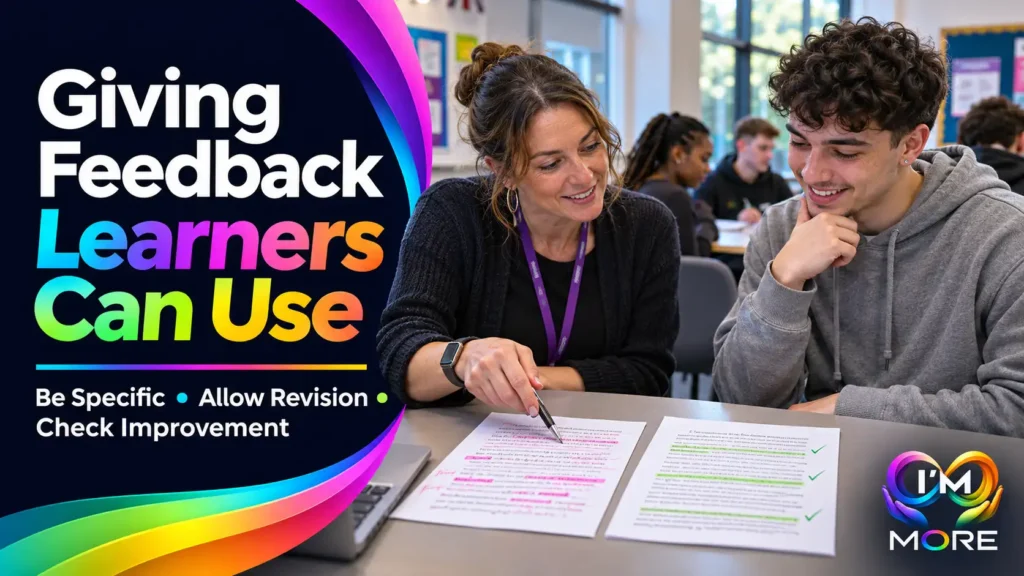
A learner can receive a page of comments and still be unsure what to do next. ‘Add more detail’ may sound helpful to a teacher who can already see what is missing. To the learner, it can leave the original difficulty untouched. Feedback needs a clear connection between the work, the intended learning and an action the person can attempt.
Useful feedback starts before marking. Teachers need to explain the task, teach the relevant knowledge and look at what learners currently understand. Their response can then address a real gap rather than repeat a general instruction. Learners also need time and support to use the information while it is still connected with the work.
At IM MORE, Discover, Believe, Become provides a supportive structure. Discover what the learner understands, build belief by identifying accurate progress and help them become more capable through a focused revision. The aim is to improve learning through a conversation the learner can act on.
Begin with the intended learning
Decide what the task was meant to teach or reveal. If the focus is explaining a cause, feedback should address whether the learner has connected the cause with its effect. Correcting every spelling issue first may draw attention away from that central need, unless spelling is the specific learning goal.
Share the criteria before learners attempt the work and use an example to explain them. A phrase such as ‘clear explanation’ needs unpacking. Show what the reader should understand and which part of an example provides that information. Feedback becomes easier to interpret when the learner recognises the standard it refers to.
Find out why the difficulty occurred
Look at the work and ask a short question where necessary. A missing explanation might mean the learner does not understand the concept, cannot express the connection or thought a list was sufficient. The same written gap can have different causes and therefore require different teaching.
Avoid treating all errors as carelessness. Ask the learner to talk through the decision or demonstrate the step. If the knowledge is missing, provide further instruction. If the learner understands but omitted a check, help them build that check into their process. Feedback should respond to what you learn about the difficulty.
Identify a specific successful feature
Tell the learner what is already working and why. ‘Your example directly supports the point about cost’ identifies something they can recognise and repeat. General praise may encourage them, but it gives less guidance about the subject learning.
Keep the observation accurate. Do not call a piece complete when an important part remains missing. A learner can hear that one decision was effective while understanding that another needs work. This balance supports a clear picture of progress and avoids making feedback feel like a sudden reversal of earlier reassurance.
Choose a manageable priority
Select the change most likely to help the next attempt. A learner who receives ten different instructions may struggle to decide which one to begin. If the main issue is that evidence has been included without explanation, focus the response on building that connection first.
Other issues can be addressed later or through shared teaching where they recur across the class. Keep a note when an important gap needs follow-up. Choosing a priority does not mean ignoring the rest of the learning; it means making the immediate action possible within the time and support available.
Turn the comment into a usable action
Replace a vague direction with a question or instruction tied to the work. Instead of ‘explain more’, ask the learner to add a sentence showing how the chosen detail supports their claim. Point to the relevant place and model a different example if the process is unfamiliar.
Then check that the learner understands the request. Ask them to describe what they will change before beginning. The EEF feedback guidance focuses on feedback principles for ages 5 to 18. Its relevance to an adult group should be considered alongside the subject and learners’ needs.
Choose the delivery method for the purpose
Some feedback is easiest to give through a short spoken conversation. Other feedback needs a written prompt that the learner can revisit. A demonstration may be most useful when the difficulty involves a practical process. Select the method that makes the required action understandable and accessible.
Avoid assuming that more written comments automatically create more learning. Watch what the learner does after receiving the information. If a spoken explanation is quickly forgotten, agree a short written reminder. If written comments are repeatedly misunderstood, discuss an example together and check what the learner has taken from it.
Make time for revision within the lesson
Plan a period when learners can use feedback while you are available to help. Ask them to revise a specific section or complete a related example. This gives you evidence about whether the response clarified the issue and whether more teaching is needed.
Keep the task proportionate. Rewriting an entire assignment may not be necessary to practise one explanatory sentence. A focused revision can make the change easier to see. Ask learners to identify what they changed and why, so the activity involves understanding rather than copying the teacher’s wording into a new version.
Use shared feedback without losing individual needs
When several learners make the same mistake, teach it to the group using an anonymous or fictional example. Explain the problem, model a repair and ask everyone to locate a similar issue in their own work. This can make efficient use of teaching time.
Check individual application afterwards. A class explanation may be clear to some learners and still leave others uncertain. Visit those who need another example and ask them to explain the change they are making. Avoid assuming that showing a corrected paragraph means every learner can now use the principle independently.
Teach peers how to give useful responses
Begin with one clear feature to review and model a respectful comment. A partner might identify where evidence supports a claim and ask where the connection needs explaining. Provide an example of a helpful response before expecting learners to evaluate each other’s work.
Keep the teacher responsible for checking subject accuracy. Peers may repeat a misunderstanding or focus on presentation because it is easier to notice. The EEF literacy guidance offers further school-based reading on subject communication. Adapt any peer routine to the task and check the feedback learners actually exchange.
Handle emotional responses respectfully
A learner may hear correction through the memory of earlier criticism. Give feedback privately when appropriate and keep the language attached to the work. Allow them time to ask questions. Disagreement can also reveal that the instruction or criterion was unclear, so listen before repeating the same judgement.
Where a learner connects a difficult result with feeling worthless, IM MORE’s article on unemployment and self-worth may help a wider conversation. In the lesson, explain the specific issue and the available support. The feedback should leave the person with a clearer next action rather than a judgement about their character.
Try a short revision sequence
In a lesson about explaining a scientific observation, learners first write a short response using knowledge already taught. Read the responses and choose one common gap, such as naming a result without explaining the process. Model how to add the missing connection using a different observation.
Learners revise their own response and underline the added explanation. Ask a few to explain why the change helps. At the next lesson, give a fresh observation and check whether the explanation appears without the same prompt. This provides more useful evidence than counting how many comments were written on the original work.
Close the feedback conversation with a check
After a learner makes a revision, ask them to explain how it addresses the original issue. This short conversation can reveal whether the change reflects understanding or follows an instruction they cannot yet use independently. Respond to that difference through the next example you provide.
Invite a question about the feedback as well. Learners may be uncertain about a word you used or about how much they should change. Clarifying the request can prevent unnecessary rewriting and keep the work focused. If several learners ask the same question, review the clarity of your original comment. Feedback is a shared communication task, and teachers can improve the way they express it as well as the advice it contains.
Review whether the feedback changed learning
Look at the revision and the later independent attempt. A corrected sentence shows that the learner responded in the moment. A suitable explanation in a new task suggests the learning may be becoming more secure. If the problem returns, investigate whether the feedback addressed the underlying gap.
Begin with one task next week. Clarify the goal, identify a priority and reserve time for learners to act. During Discover, find the need; during Believe, acknowledge the improvement; during Become, check independent use. Feedback earns its place in teaching when it helps learners understand and improve the decisions they make.