

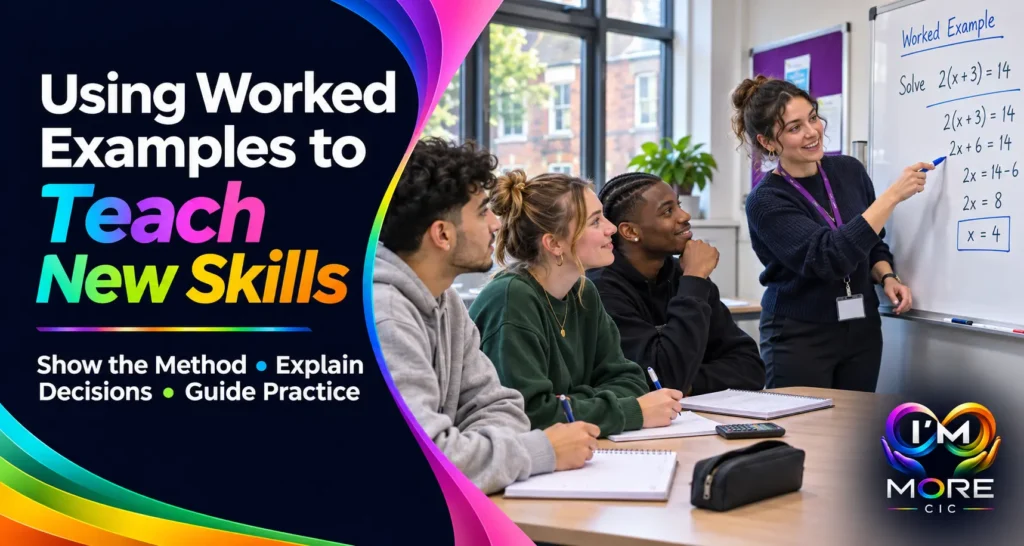
Using Worked Examples in Teaching
Watching a teacher produce a correct answer can make a task look straightforward. The difficulty appears when learners try it themselves and cannot see how to make the first decision. A finished answer shows the destination, but learners may also need to understand the choices that produced it.
A worked example makes a process available for study. It can show how a calculation is organised, how evidence is selected or how a short written response is developed. Used thoughtfully, it gives teachers a way to explain the reasoning before asking learners to manage the whole task independently.
At IM MORE, Discover, Believe, Become can connect this teaching with the learner’s experience. We discover the step that needs support, build belief through guided attempts and help learners become more independent when they can use the method themselves. The example should serve that learning purpose rather than become something to copy without thought.
Choose a task with a clear teaching purpose
Select an example that makes one important process visible. If the lesson concerns calculating the cost of several identical items, use simple prices at first so learners can focus on choosing and organising the operation. Complicated figures could hide the decision you want to explain.
Know what learners should understand by the end. They may need to recognise when multiplication is appropriate, set out the calculation or explain the result in context. Those aims influence what you demonstrate and which questions you ask. Avoid trying to teach every possible variation through a single densely annotated example.
Check the foundations before demonstrating
Ask a short question about the knowledge the example assumes. A learner might understand repeated addition but be uncertain about the multiplication symbol. Another may know the operation and struggle with decimal notation. Identifying the starting point helps you make the demonstration relevant.
Teach a missing prerequisite directly when necessary. An example cannot reliably explain a new method if its language and notation remain unfamiliar. You can still keep the main learning goal, but adjust the route towards it. Use a brief explanation or simpler representation, then check whether learners are ready to follow the intended process.
Show the reasoning alongside the action
Demonstrate one step at a time and explain the choice you are making. A teacher might say that the question gives the price for one item and asks about four identical items, so the same amount must be included four times. The explanation connects the operation with the situation.
Keep the spoken reasoning concise. Too much commentary can make it harder to follow the actual step. Show the relevant information beside the calculation and point to the connection. Pause at a decision that learners will need to make later, giving them time to explain it before you continue.
Keep the presentation easy to follow
Use a clear layout with enough space between stages. Place an explanation near the part it describes so learners do not need to search across several pages. Remove decorative details that compete with the essential information and make sure the example remains readable from the learners’ seats.
Offer an accessible copy when needed and explain visual information aloud. The EEF explicit instruction resources describe demonstration and practice in schools. For young adult settings, use the idea as a planning resource and check whether your particular presentation makes the process easier to understand.
Ask learners to explain the choices
After showing a step, ask why it makes sense. Learners could identify the information used, explain what a number represents or describe what would go wrong with another approach. These questions help you see whether they are following the reasoning or only the appearance of the answer.
Give everyone time to think before collecting responses. A brief written explanation or paired discussion can widen the evidence beyond the quickest answer. Correct misunderstandings promptly and make the accurate reasoning explicit. If the group cannot explain a key step, return to it before adding more decisions to the task.
Compare examples that reveal a difference
Once learners understand a basic method, show a related example that changes one important feature. Compare the cost of four identical items with a total that includes different prices. Ask whether the first method still fits and why. This helps learners attend to the structure of the problem.
Keep the comparison focused. If the numbers, context and task all change at once, learners may not notice the feature that matters. Ask them to point out the change and explain its consequence. A worked example becomes more useful when learners can judge where its method applies rather than treating it as a universal recipe.
Introduce incomplete examples carefully
Provide an example with one step missing and ask learners to complete it. Choose the gap to match what you need them to practise. They may be ready to calculate a total while still needing the setup provided, or ready to choose the operation before working through the arithmetic.
Check the explanation as well as the completed step. A correct missing number may come from guessing. Ask what the step represents and how it follows from the information given. Reduce support when the responses show readiness, and provide another demonstration when they reveal a gap that practice alone is unlikely to resolve.
Move towards a fresh independent task
After guided work, offer a new example that requires the same underlying skill. Change the details enough that learners must make the relevant decision. Avoid leaving the full answer directly beside the task if you need to find out what they can now manage independently.
Observe where learners pause. Someone may select the right operation but need help checking the result. Another may calculate confidently after you identify the operation for them. These are different teaching needs. Record the important distinction and use it to plan the next opportunity rather than giving everyone the same general advice to practise more.
Use errors to teach checking
Create a clearly fictional example with one plausible mistake. Explain that the purpose is to examine the method, then ask learners to locate and correct the error. Avoid using an identifiable learner’s work in a way that could cause embarrassment or discourage future attempts.
Model a checking question, such as whether the total should be larger than the price of one item. Ask learners to explain why their correction is sensible. The EEF metacognition guidance offers further school-based material on making planning and monitoring visible within subject teaching.
Apply worked examples beyond mathematics
In a writing lesson, demonstrate selecting a piece of evidence for a claim. Show two possible quotations and explain why one is more relevant. Write a short explanation of the connection, then ask learners to choose evidence for a different claim with your support.
In a practical subject, demonstrate a safe procedure in line with the setting’s requirements and explain the checks that matter. Learners then practise under the appropriate supervision. A written example can support that teaching, but it should not replace the practical instruction and observation needed for a task where technique or safety must be demonstrated.
Connect supported practice with learner belief
During Discover, ask where the process becomes unclear. During Believe, notice when the learner can explain a decision or complete a step with less prompting. During Become, help them recognise when they can choose and use the method in a different task.
Some learners interpret needing an example as evidence that they are behind everyone else. Explain that examples are part of how the class studies a new process. IM MORE’s article on unemployment and self-worth can support a wider conversation about confidence, while classroom feedback remains focused on the skill being learned.
Keep examples available as purposeful references
Give learners a clear way to find an example when it is useful during practice. Label it by the method or decision it explains, rather than only by the date. Ask learners which part they consulted and how it helped. This can show whether they are using the example to guide reasoning or simply copying its surface features.
When checking independent understanding, explain which references are available and why. A learner may legitimately use a resource in ordinary practice while also needing a separate opportunity to show what they can do unaided. Keep those purposes distinct in your observations. That prevents a successful supported task from being interpreted as evidence of complete independence before it has been demonstrated.
Review how much support is still useful
Keep a small record of which steps learners complete independently. If a learner can already explain and apply the method, another fully worked version may add little. Offer a comparison, an unfamiliar context or a task requiring them to select between methods instead.
For your next lesson, choose one decision that learners often find difficult. Prepare a simple worked example that explains that decision, a partially completed version and a fresh task. Use the responses between stages to decide how quickly to move. The value lies in helping learners understand and use the process with growing independence.













