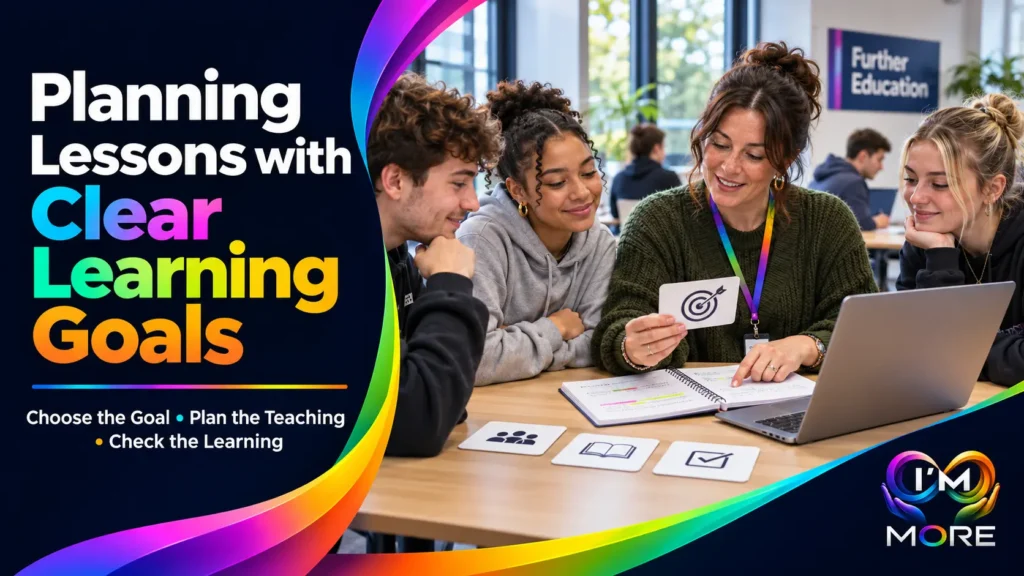
A busy lesson can finish with completed worksheets and still leave the teacher unsure what anyone learned. Learners may remember the activity without understanding the idea it was meant to teach. Planning begins to become more useful when we can describe what learners should know or do afterwards, and decide how we will recognise that learning.
For teachers and tutors supporting young adults, clear goals also make expectations easier to understand. Someone returning to education may be willing to try but uncertain about what counts as a successful attempt. A specific goal gives that person something concrete to work towards and gives the teacher a basis for choosing explanations, examples and practice.
At IM MORE, Discover, Believe, Become can help connect this planning with the learner’s experience. We discover their starting point, support belief through achievable learning and help them become more capable through practice. The classroom suggestions below show how that can work without turning a lesson plan into a long administrative exercise.
Describe the learning before choosing the activity
Begin with a sentence that names the knowledge or skill. Instead of planning to complete a poster about communication, decide whether learners need to identify features of a clear message or write one themselves. Those goals require related but different teaching. A poster could support either, but making it attractive would not demonstrate the intended learning.
Choose a goal small enough to teach and check within the available time. In a writing session, learners might practise giving a reason that supports a claim. They do not need to master every feature of persuasive writing in the same lesson. A manageable focus makes it possible to explain the idea properly and provide time to use it.
Check the knowledge learners will need
Before introducing a new task, identify what it assumes. Comparing two arguments requires understanding the texts and knowing what a supporting reason looks like. If those foundations are missing, a demanding discussion may mainly expose gaps that have not yet been taught.
Use a brief starting question or example to find out what learners can currently do. Ask them to identify the reason in a short statement, then explain their choice. Treat the response as information for planning. A qualification or confident manner can suggest previous experience, but it does not replace looking at the relevant knowledge in this group.
Decide what evidence would show understanding
Write the final check before planning every stage of the lesson. If the goal is to support a claim with a reason, the check could ask learners to improve a new statement and explain their change. This helps you avoid spending the whole session on activities that never require the target skill.
Keep the check short and aligned with the goal. Asking whether learners enjoyed the activity provides useful feedback about their experience, but it does not establish that they can apply the idea. The EEF feedback guidance connects learning intentions and assessment of gaps. Its school focus means applications to adult groups need professional judgement.
Explain what success will look like
Share the goal in language learners can use. Explain unfamiliar terms, and show a short example of the expected quality. A statement such as ‘give one relevant reason that explains your choice’ is easier to act on when learners can see what makes a reason relevant.
Discuss an incomplete example alongside a stronger one. Ask what the second adds and why it helps the reader. Keep the examples close enough that the difference is visible. If one is much longer, learners may assume that quantity alone makes it better. Draw attention to the feature you actually want them to practise.
Plan an explanation and a demonstration
Decide how you will introduce the idea before expecting learners to attempt it. Prepare a concise explanation, then demonstrate a small task while saying why you make each choice. A teacher might reject an interesting detail because it does not support the claim, showing that selection is part of writing.
Leave space for learners to question the demonstration. Ask them to predict a next step or explain why a particular reason fits. Their responses can reveal whether the explanation has landed. The EEF resources on explicit instruction provide further school-based examples of demonstration and practice.
Build a sequence that changes responsibility
After the demonstration, work through a related example together. Invite learners to choose a reason and explain how it connects with the claim. Offer prompts when needed, but allow enough thinking time for someone to attempt the decision before supplying it yourself.
Then give an individual task that uses the same idea with different content. This shift matters because a group answer can hide uncertainty. You need to see what each learner can do when the teacher is no longer completing the reasoning. If many struggle, return to a smaller example and examine the difficult decision together.
Make the lesson accessible without losing its purpose
Consider whether reading demands, layout or unfamiliar language could block access to the intended learning. If the goal concerns reasoning, a lengthy text may introduce an unnecessary obstacle. A shorter passage can preserve the intellectual challenge while making the relevant information easier to find.
Plan support based on what learners need now. Some may benefit from a spoken explanation of the text, a glossary or a prompt linking the reason to the claim. Others may be ready to compare the strength of two plausible reasons. Avoid assigning a permanent level of challenge from a single early response.
Protect time for practice and feedback
Estimate how long each stage genuinely needs, including distributing materials and explaining the task. An ambitious plan can leave only a few minutes for the part where learners use the new knowledge. If time is tight, remove an optional activity before removing the opportunity to practise.
Build in time for learners to act on feedback. A teacher comment about relevance becomes useful when the learner revises the reason and checks whether it now supports the claim. Without that opportunity, the feedback may remain something heard or read rather than something used to improve the work.
Prepare a response when the class needs more teaching
Choose a point where you will check understanding before increasing difficulty. Plan a question that distinguishes a relevant reason from an unrelated fact. Decide what you could explain again if responses show confusion. This makes adapting the lesson easier than inventing a complete alternative while teaching.
The response does not need to be elaborate. You could compare two reasons, remove distracting information or model the link in a different context. If only a few learners need further instruction, work briefly with them while others apply the skill to a more demanding example. Recheck understanding before continuing.
Use a practical lesson example
Imagine a session on recommending a book for a class reading collection. The goal is to support a recommendation with a relevant reason. Begin with two short recommendations and ask which helps the reader decide. Use the answers to establish what the group already understands about giving reasons.
Model selecting a reason connected to the intended reader, then create another recommendation together. Learners write their own using a different book description. Ask them to underline the claim and circle the reason. A partner can question the connection, but each learner makes their own revision. Finish with a new example that everyone completes individually.
Connect clear goals with learner confidence
During Discover, ask learners what they already understand and where the task becomes uncertain. During Believe, help them recognise a specific improvement, such as replacing a general opinion with a relevant explanation. During Become, ask them to use the same reasoning in a fresh piece of writing.
Some learners may connect a difficult lesson with a wider fear that they are incapable. IM MORE’s article on unemployment and self-worth can support a separate conversation about personal value. Within the lesson, keep judgements focused on the work and the next teaching step. A missed goal describes learning that still needs support.
Plan resources around the teaching decisions
Check each resource against the goal before printing or sharing it. A worksheet may contain useful questions alongside sections that introduce unrelated demands. Remove or postpone those sections when they do not serve the current sequence. Make sure the example you demonstrate and the task learners attempt use compatible language and notation.
Prepare a usable version of the final check as well. If the lesson runs short, you still need a brief opportunity to see what learners understood. You could reduce the number of practice items while preserving one independent response. This helps the plan retain its purpose when the timetable changes, rather than ending with activity completed and understanding still unclear.
Review the plan through the learners work
Afterwards, compare the final responses with the learning goal. Notice which part learners managed independently and which still needed prompting. Record one useful change for the next lesson. You might need another example, a clearer explanation of relevance or more practice linking evidence with a claim.
Keep the review specific enough to influence teaching. ‘The class was engaged’ is encouraging, but ‘six learners gave reasons that did not connect with their claim’ tells you what to address. Start your next plan with that information. Clear learning goals become useful when they guide what you teach, what learners practise and what happens after you check their understanding