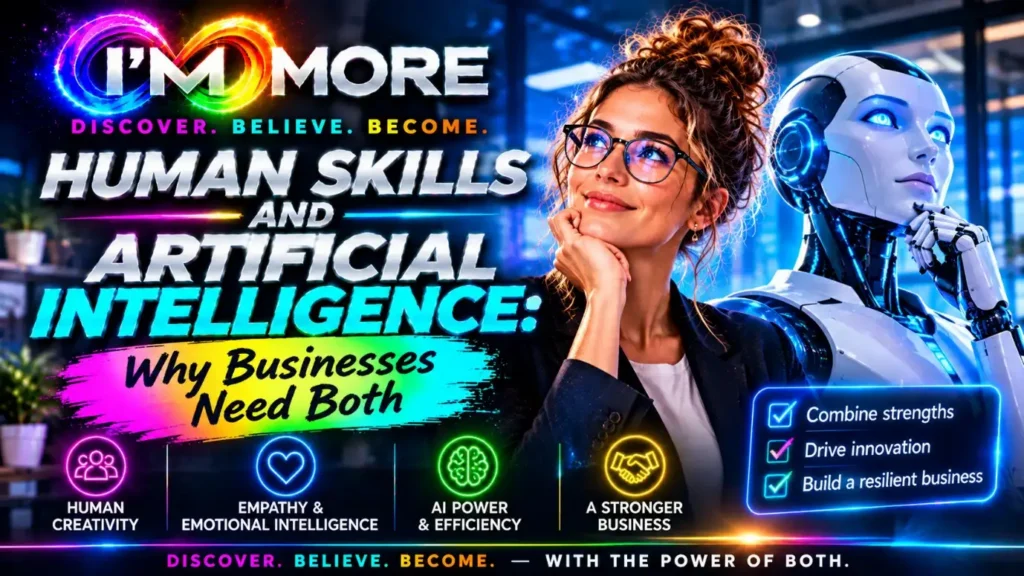
Human skills and artificial intelligence are both essential for businesses, helping organisations combine technology with creativity, communication, critical thinking and human understanding.
AI can help businesses work faster, make better use of information and improve productivity. But behind every successful business are people who bring creativity, understanding, judgement and human connection. So, why is the future of business about combining human skills with artificial intelligence rather than choosing one over the other?
Artificial intelligence is changing the way businesses operate. From writing marketing content and analysing information to answering customer questions and automating everyday tasks, AI is creating opportunities for organisations of all sizes.
For business owners, employees and people starting their careers, understanding AI is becoming an increasingly valuable skill. You can explore more practical articles in the IM MORE Tech Wiz section. However, as technology becomes more capable, something else is becoming clear: human skills are not becoming less important. In many ways, they are becoming even more valuable.
AI can process information, recognise patterns and generate ideas, but it does not replace the experience, empathy, imagination and judgement that people bring to the workplace.
The strongest businesses will be those that understand how to bring these abilities together.
1. AI Can Improve Productivity, but People Provide Direction
One of the biggest advantages of artificial intelligence is its ability to help businesses save time.
AI tools can assist with tasks such as:
- Drafting emails, reports and documents.
- Organising information and summarising research.
- Creating first drafts of marketing content.
- Generating ideas for products and services.
- Supporting customer enquiries.
- Helping teams plan and organise their work.
These tools can reduce the time spent on repetitive activities and give employees more opportunity to focus on other responsibilities.
However, AI still needs direction. It does not automatically understand a business’s priorities, values or long-term ambitions.
For example, an AI tool might generate a marketing campaign, but a person needs to decide whether the message reflects the brand, appeals to the right audience and communicates something meaningful.
The key lesson: AI can help complete tasks, but people need to decide what matters, why it matters and what should happen next.
2. Creativity Is More Than Generating Ideas
AI can produce suggestions, images, designs, articles and even business concepts. This makes it a useful tool for exploring possibilities and overcoming the challenge of starting with a blank page.
But creativity involves more than producing something new.
Human creativity is influenced by personal experiences, emotions, culture, curiosity and the ability to see opportunities from different perspectives.
A business might use AI to generate ten ideas for a new product. However, it takes human understanding to recognise which idea solves a genuine problem, connects with customers and fits the business’s identity.
People also bring originality through their own stories, experiences and ways of thinking.
How businesses can combine both:
- Use AI to explore different ideas and possibilities.
- Encourage employees to question and improve AI suggestions.
- Bring different perspectives into creative discussions.
- Use human judgement to select and develop the strongest ideas.
- Make sure the final result reflects the business’s personality.
AI can support the creative process, but people give ideas purpose and meaning.
3. Communication and Emotional Intelligence Still Matter
Successful businesses depend on relationships. Whether dealing with customers, employees, suppliers or business partners, communication plays an important role in building trust.
AI can help businesses respond to enquiries, draft messages and provide information. However, good communication involves understanding what another person needs and how they might be feeling.
This is where emotional intelligence becomes important.
Emotional intelligence includes the ability to:
- Recognise and understand emotions.
- Listen carefully to other people.
- Show empathy and consideration.
- Manage disagreements constructively.
- Adapt communication to different situations.
- Build positive working relationships.
Imagine a customer contacts a business because an order has gone wrong. An automated response might explain the returns process, but a member of staff may need to understand the customer’s frustration, take responsibility and find an appropriate solution.
The information matters, but so does the way the customer is treated.
People remember how a business makes them feel. AI can support communication, but human understanding helps create meaningful relationships.
4. Critical Thinking Helps Businesses Make Better Decisions
AI can analyse large amounts of information and produce recommendations. This can help businesses explore options and make sense of information that might otherwise take considerable time to review.
However, AI-generated answers are not automatically correct.
Information may be incomplete, out of date, misleading or presented without important context. AI can also produce confident-sounding responses that contain mistakes.
This is why critical thinking is essential.
Critical thinking means questioning information, checking evidence, considering different viewpoints and making decisions based on sound reasoning.
For example, a small business might ask AI to analyse customer feedback and suggest ways to increase sales. The suggestions could be useful, but the business owner still needs to consider whether the information is accurate, whether the recommendations are realistic and whether they suit the customers they actually serve.
How to use critical thinking alongside AI:
- Check important facts and figures.
- Question recommendations rather than accepting them immediately.
- Consider where information has come from.
- Compare AI suggestions with real customer feedback.
- Think about possible risks and unintended consequences.
- Take responsibility for the final decision.
AI can help businesses understand information, but people must decide what to do with it.
5. Leadership Requires Human Understanding
Leadership is not simply about setting targets, organising tasks or monitoring performance. Good leaders motivate people, build confidence, manage challenges and help teams work towards a shared purpose.
AI can support managers by helping with planning, analysing performance information and organising workloads. But leadership also involves understanding individuals and responding to situations that are often complicated or sensitive.
For example, an AI system might identify that an employee’s performance has changed. However, it cannot reliably understand all the circumstances behind that change.
A good manager needs to have a conversation, listen without making assumptions and consider what support might be appropriate.
Strong leadership also involves making difficult decisions, communicating honestly and creating an environment where people feel valued.
Businesses that use AI effectively should give their leaders more opportunity to focus on people, not less.
6. Adaptability and Problem-Solving Are Essential in a Changing Workplace
Technology continues to develop, and businesses need people who are willing to learn, adapt and approach new challenges with an open mind.
Adaptability is the ability to respond positively when circumstances change. Problem-solving involves identifying challenges, exploring possible solutions and deciding on the best way forward.
AI can help people investigate problems and generate possible solutions, but real situations do not always follow a predictable pattern.
A business might use AI to identify a potential problem with its website or customer service process. Employees then need to investigate what is happening, understand the impact and decide how to resolve it.
These skills are particularly important for young people entering the workplace. You do not need to know everything about technology, but being willing to learn and develop new skills can make a real difference.
A useful approach is to become comfortable learning alongside technology rather than feeling threatened by it.
7. Businesses Need People Who Understand Both AI and Human Skills
The future workplace will not simply need people who know how to use AI tools. It will need people who understand when to use them, how to check their output and where human involvement is essential.
This creates an opportunity for employees, entrepreneurs and people developing their careers. The National Careers Service also provides careers information and guidance to help people explore their skills and future opportunities.
Some valuable skills to develop include:
- Digital confidence: Understanding how to use technology and AI tools appropriately.
- Communication: Explaining ideas clearly and listening to others.
- Creativity: Thinking differently and developing original approaches.
- Critical thinking: Questioning information and making informed decisions.
- Emotional intelligence: Understanding people and building relationships.
- Problem-solving: Finding practical ways to overcome challenges.
- Adaptability: Being willing to learn and respond to change.
- Responsibility: Understanding the consequences of decisions and taking ownership of your work.
You do not need to become an expert in every area. The important thing is to keep developing a combination of technical knowledge and transferable human skills.
These abilities can help you contribute to a business, start your own venture or prepare for opportunities that may not even exist yet.
8. How Businesses Can Bring Human Skills and AI Together
Using AI effectively is not simply about introducing new software. Businesses need to think carefully about how technology fits into their everyday activities and how it supports the people using it.
Here are five practical ways to bring the two together.
1. Identify tasks where AI can help
Look for repetitive or time-consuming activities that could be supported by AI. This might include drafting routine communications, organising information or producing initial content.
2. Keep people involved in important decisions
Use AI to provide information and suggestions, but make sure people review the output and take responsibility for decisions that affect customers, employees and the business.
3. Invest in human skills
Provide opportunities for employees to improve communication, creativity, leadership, teamwork and problem-solving.
4. Encourage responsible AI use
Make sure employees understand privacy, accuracy, confidentiality and the importance of checking AI-generated information. Businesses should also have clear guidelines about which tools can be used and for what purposes. Resources from UNESCO on artificial intelligence provide further information about AI and its responsible use.
5. Review what is working
Ask employees and customers for feedback. Consider whether AI is genuinely improving the experience, saving time or solving a problem. If it creates more difficulties than it removes, the approach may need to change.
The aim should be to use technology to strengthen the business and support its people.
9. A Simple Plan to Develop Your Human and AI Skills
Whether you are a business owner, an employee, a student or someone considering a new career, you can start developing these skills now.
Try this six-step approach:
Step 1: Explore AI tools
Choose one accessible AI tool and experiment with how it can help you with a practical task. Learn what it can do and where it has limitations.
Step 2: Practise asking better questions
The quality of an AI response often depends on the instructions you provide. Practise explaining what you need, giving relevant context and asking for improvements.
Step 3: Strengthen your communication
Practise writing clearly, listening carefully and explaining your ideas. These skills are valuable whether you are working with people or using technology.
Step 4: Question the answers
Do not automatically accept everything AI produces. Check information, look for reliable evidence and use your own judgement.
Step 5: Develop your creativity
Try different approaches to solving problems. Use AI to explore ideas, but challenge yourself to add your own perspective.
Step 6: Keep learning
Technology will continue to change, so make learning part of your routine. Develop your digital knowledge while continuing to build the human skills that help you work effectively with others.
Small improvements over time can help you become more confident and prepared for the changing world of work.
Conclusion: The Future Belongs to People Who Know How to Work With AI
Artificial intelligence is creating exciting opportunities for businesses. It can help people work more efficiently, explore ideas, analyse information and improve everyday processes.
But technology alone does not create a successful business.
Businesses still need people who can think creatively, communicate with empathy, solve problems, lead teams and make responsible decisions. These human abilities give technology direction and help ensure it is used in ways that benefit people.
The real opportunity is not to compete against AI or rely on it to do everything. It is to understand how human abilities and artificial intelligence can complement one another.
For young people, employees and aspiring entrepreneurs, this is an important message: learning how to use AI is valuable, but developing your human skills is just as important.
AI can give you tools. Your human skills help you decide what to do with them.
At IM MORE, we believe the future is about discovering your potential, believing in your abilities and becoming confident in a world that continues to change.
Discover. Believe. Become.