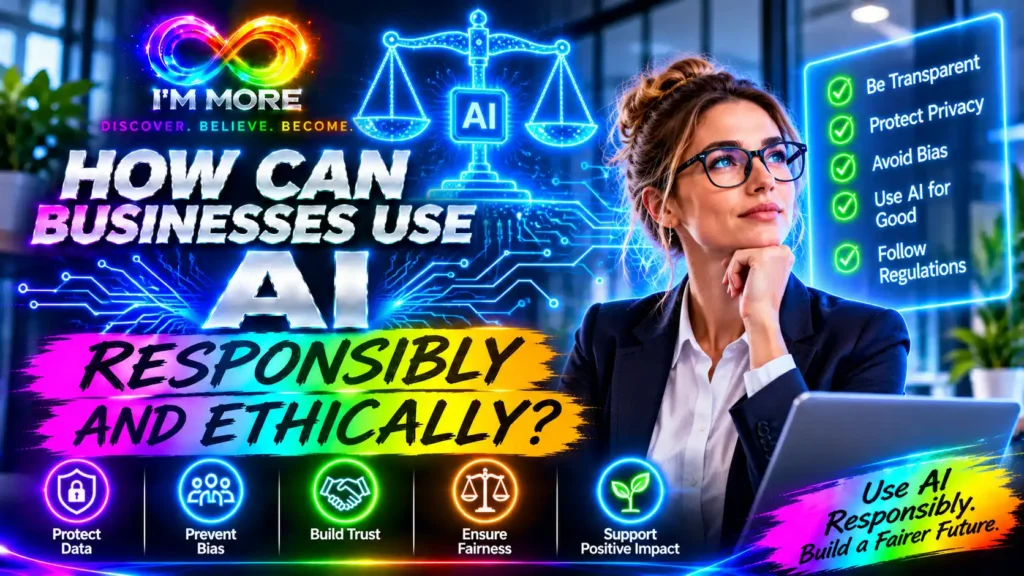
How Can Businesses Use AI Responsibly and Ethically?
Introduction: innovation needs responsibility
Artificial intelligence is giving businesses new ways to work. It can help teams analyse information, respond to customers, create content, automate routine tasks and explore new ideas. For small businesses and larger organisations alike, these capabilities can create opportunities to save time, improve services and make better use of resources.
But adopting AI also brings responsibilities. A tool may produce inaccurate information, reflect unfair patterns in its training data, expose sensitive information or make it difficult for people to understand how a decision was reached. If businesses use AI without thinking about these risks, they can damage customer confidence, affect employees and create legal or reputational problems.
Using AI responsibly does not mean avoiding innovation. It means making thoughtful choices about where the technology is appropriate, what safeguards are needed and who remains accountable. The aim is to use AI in ways that are useful, fair, transparent and respectful of the people affected.
1. Be clear about why you are using AI
Responsible AI starts with a clear purpose. Before introducing a tool, identify the business problem you want to solve. Are you trying to reduce repetitive administration, help customers find information, improve the quality of internal reports or support staff with research?
A defined purpose makes it easier to decide whether AI is suitable and what a successful result should look like. It also helps prevent businesses from collecting unnecessary information or using a tool for tasks it was never designed to perform.
For example, AI may be useful for drafting a first version of a customer newsletter. A member of staff can check the details, adjust the tone and approve the final message. By contrast, allowing an AI system to make an important decision about a person’s employment or access to a service without meaningful human oversight creates much greater risks.
Ask three simple questions before starting: What benefit are we expecting? Who could be affected? What could go wrong if the output is inaccurate?
2. Protect personal and confidential information
AI tools may process the information users enter, upload or connect to them. That information could include customer names, contact details, payment information, employee records, supplier contracts, business plans or commercially sensitive data.
Before using an AI service, understand what happens to the information you provide. Check the provider’s privacy policy, data retention settings, security features, access controls and whether inputs may be used to improve its models. Use an organisation-approved service for business information and avoid entering personal or confidential details into tools that have not been assessed.
Only use the information needed for the task. Where possible, remove names and other identifying details. Restrict access to people who need it, and make sure staff understand what they may and may not share.
For UK organisations, the Information Commissioner’s Office provides guidance on AI and data protection covering important considerations when personal information is involved. Businesses should assess their own obligations rather than assuming that using an AI tool removes their responsibility.
3. Check accuracy and do not assume AI is always right
AI systems can produce convincing answers that contain mistakes. They may invent sources, misunderstand instructions, use outdated information or present an uncertain conclusion as though it were a fact. This is sometimes described as an AI hallucination.
For business owners, the consequences can be significant. Incorrect prices, product details, legal explanations, financial figures or delivery promises can mislead customers and create avoidable disputes.
Treat AI output as a draft, recommendation or starting point. Check factual claims against reliable sources, verify calculations using the original data and ask a knowledgeable person to review anything important before it is shared or acted upon.
The level of checking should match the risk. A brainstorming list may need a quick sense-check. A financial forecast, customer-facing policy or safety-related instruction requires much more careful verification.
4. Make AI use fair and avoid harmful bias
AI systems can reflect patterns and assumptions in the data used to build or operate them. If those patterns are unfair, the output may disadvantage particular people or groups. Bias can also enter through the way a business frames a task, chooses its data or interprets a recommendation.
This matters when AI is used in recruitment, customer eligibility, pricing, lending, staff evaluation or decisions about access to services. A system may appear neutral while producing outcomes that are unfair or difficult to challenge.
Businesses should consider who might be affected, test outputs across relevant situations and look for patterns of unequal treatment. Do not rely on AI as the sole decision-maker for significant decisions about individuals. Keep a qualified person involved, document the reasoning and provide a way for people to ask questions or challenge an outcome.
Fairness is not something that can be guaranteed by a single software setting. It requires ongoing attention to the data, the process and the real-world impact of the system.
5. Be transparent with customers and employees
People should not be left confused about whether they are interacting with AI or how AI is being used in a process that affects them. Transparency helps people understand what to expect and when a human can step in.
If a website uses an AI chatbot, make its role clear and explain how customers can contact a person. If AI is used to help prepare a customer communication, make sure the final message is accurate and that the business remains responsible for it. If staff are expected to use AI tools, explain which tools are approved and what information can be entered.
Transparency does not mean overwhelming people with technical explanations. It means providing clear, relevant information at the right time. Be honest about what the system can do, where its limitations are and how people can raise concerns.
6. Keep people accountable for important decisions
AI can support decisions, but responsibility should remain with the business and the people authorised to act. A company cannot avoid accountability by saying that an algorithm made the recommendation.
Set clear rules about which tasks AI may assist with and which decisions must remain under human control. Define who reviews outputs, who approves actions and who responds when something goes wrong. Staff should have the authority and confidence to question an AI result rather than accepting it automatically.
Human oversight needs to be meaningful. A person should have enough information, time and authority to assess the recommendation and change the outcome when necessary. Simply clicking approve without understanding the result is not an effective safeguard.
7. Respect copyright, ownership and original work
AI-generated text, images, audio and other material can raise questions about copyright, permissions and ownership. The legal position can depend on the type of material, how the tool was trained, the terms of the service and the way the output is used.
Do not assume that every image, logo, quotation or passage generated by a tool is automatically free from rights issues. Avoid asking AI to reproduce a living artist’s distinctive work or to copy protected material. Check the tool’s terms, use properly licensed assets and obtain permission where required.
For business content, review generated material for copied phrases, inaccurate quotations, misleading claims and brand conflicts. Keep records of the sources and assets used in important campaigns or publications.
8. Secure AI tools and manage access
AI services can become part of a business’s technology environment, so they need appropriate security. Use strong authentication, limit access according to job roles and review connected apps or integrations. Be cautious about browser extensions, plug-ins and third-party tools that request access to business files or customer systems.
Keep software up to date and understand how information moves between connected services. Consider what could happen if an account is compromised or a tool is given access to more information than it needs.
For organisations developing a more formal approach, the
NIST AI Risk Management Framework provides a structured way to identify, assess and manage risks associated with AI. It can help businesses think about governance, mapping potential impacts, measuring performance and managing issues over time.
9. Train staff and create clear AI-use guidelines
A responsible approach works best when everyone understands the expectations. Staff need practical guidance on approved tools, permitted uses, data protection, checking outputs, copyright and when to ask for help.
A short AI-use policy can set out the basics: which tools are approved, what information must never be entered, which outputs require review, how AI-generated content should be checked and how concerns should be reported. Keep the policy easy to find and update it as tools and business needs change.
Training should be ongoing rather than a one-off presentation. AI tools evolve, new risks emerge and staff learn best when guidance is connected to the work they actually do. Encourage people to share useful examples as well as mistakes and near misses.
10. Monitor results and respond when something goes wrong
Responsible AI use does not end when a tool is launched. Businesses should check whether it continues to perform as expected and whether it is creating unintended effects. Monitor accuracy, customer feedback, error rates, security incidents and any differences in outcomes between groups where relevant.
Create a simple process for reporting problems. Staff should know who to contact if a tool reveals confidential information, produces harmful content, gives an unsafe recommendation or makes a repeated error. Pause or restrict the use of a system if the risk cannot be managed while the issue is investigated.
Review whether the tool is still necessary and whether the benefits justify the cost and risk. If the business changes its purpose or connects the system to new data, reassess the safeguards rather than assuming the original approval still applies.
11. A practical checklist for responsible AI adoption
Before using an AI tool in your business, work through these questions:
Have we identified a clear business purpose and a measurable benefit?
Is AI appropriate for this task, or would a simpler process work better?
Do we understand what information the tool collects, stores or uses?
Have we removed unnecessary personal or confidential information?
Have we checked outputs for accuracy, bias and suitability?
Is a named person responsible for reviewing important results?
Do customers and employees receive clear information where appropriate?
Are access controls, security and supplier terms suitable?
Do staff know the rules and how to report a concern?
Will we monitor performance and review the tool regularly?
Conclusion: make trust part of your AI strategy
AI can help businesses become more productive, creative and responsive. But long-term value depends on more than speed or convenience. Customers, employees and business partners need to know that technology is being used with care and that people remain accountable for the outcomes.
Responsible AI adoption begins with a clear purpose, appropriate tools and good information. It continues through privacy protection, accuracy checks, fairness, transparency, security and meaningful human oversight. These are not obstacles to innovation; they are the foundations that allow people to use new technology with greater confidence.
You do not need a large compliance team to begin. Start with one use case, understand the risks, agree simple rules and review the results. As your experience grows, build stronger processes around the tools that genuinely help. By making ethics and responsibility part of everyday decisions, your business can benefit from AI while protecting the trust on which its success depends.