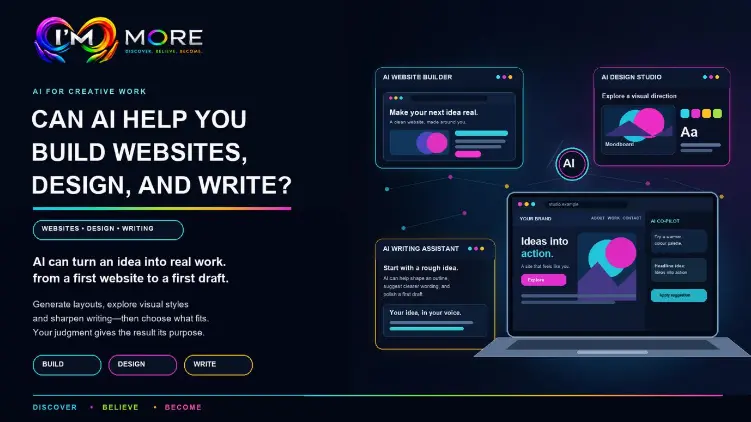
Starting a website or creative project can feel daunting, especially when you’re still learning the skills involved. Artificial intelligence (AI) can make the first steps easier. It can help people plan websites, explore design ideas and improve their writing. For students, young entrepreneurs and anyone developing a new idea, AI can be a useful assistant but it works best when a person guides and checks the results. You can explore further learning opportunities through I’M MORE’s on-demand training.
Building a website
AI can help turn a rough idea into a website plan. You might ask it to suggest pages, draft headings or explain how to build a feature. Some tools can also generate code or help find errors in code you have written.
This can save time and make website building feel more approachable. However, generated code or page content may not work as expected. A person still needs to check that the site is easy to use, works on phones, protects visitors’ information and meets accessibility needs. AI can help create a first draft, but testing and decisions still matter.
Exploring design ideas
Designers can use AI to brainstorm colour palettes, create mood boards or explore different layouts and images. This can be helpful when a blank page makes it hard to get started. AI can also quickly produce several directions to compare.
But a design needs to suit its audience and purpose. AI-generated ideas can look generic, miss important cultural context or resemble existing work too closely. Human judgment helps make the final design distinctive, appropriate and consistent with a brand. For another perspective on this topic, explore how AI can support website design.
Supporting writing
AI can help writers brainstorm topics, organise an article, suggest clearer wording or check grammar. It can be useful when you know what you want to say but need help shaping the first draft.
Still, AI can make mistakes or produce writing that sounds vague. It may state incorrect information confidently, so facts should be checked using reliable sources. Writers should also revise the draft so it reflects their own meaning and voice. Avoid sharing private or sensitive
Making Your Ideas Come to Life
One of the biggest challenges when starting a creative project is knowing where to begin. You might have an idea for a website, a business, a personal brand or a new product, but turning that idea into something real can feel overwhelming.
AI can help bridge the gap between having an idea and taking action.
For example, imagine a student who wants to create a website to showcase their skills, interests and achievements. They might not know which pages to include, what information to write or how to make the website look professional. By using ChatGPT, they can explore different layouts, develop a list of pages and receive suggestions for presenting their work.
Someone starting a small business could use AI to brainstorm business names, plan website content, develop a brand identity and explore ways to reach potential customers. You can also explore OpenAI’s business resources to learn more about how AI is used in professional settings.
The important thing is to remember that AI doesn’t need to provide the perfect answer straight away. It can help you explore possibilities, experiment with different approaches and develop your ideas over time.
Sometimes, all you need is a starting point to begin creating something you’re proud of.
Learning New Digital Skills
Technology is becoming an increasingly important part of education, employment and business. Understanding how to use digital tools can help people become more confident when approaching new challenges. You can find further guidance through I’M MORE’s employment and training resources.
AI can support this learning process by explaining unfamiliar concepts, breaking complicated tasks into smaller steps and providing examples that are easier to understand.
For instance, someone learning website development could ask ChatGPT to explain the difference between HTML, CSS and JavaScript. A beginner designer could explore the principles of colour theory, typography and layout. Someone developing their writing skills could ask for feedback on the clarity and structure of a piece of work.
Rather than simply asking AI to complete a task, learners can use it to understand how the task works and why certain approaches are effective.
This distinction matters. If you understand the process behind your work, you are more likely to develop skills that you can apply independently in the future.
AI can be a useful learning partner, but practice remains essential. Experimenting, making mistakes and trying again are all part of becoming more capable. For structured learning opportunities, OpenAI Academy provides educational resources about artificial intelligence.
Using AI to Start a Business
For young entrepreneurs and people with limited resources, starting a business can feel like a major challenge. There are many things to consider, including branding, marketing, customer research, website development and communication.
AI can help make some of these early steps more manageable.
Someone planning to launch a clothing brand, for example, could use ChatGPT to explore their target audience, brainstorm brand names, plan their website and draft descriptions for their products. They could also use AI to develop ideas for social media content and prepare questions to ask potential customers.
This can help them organise their thoughts before investing significant time or money into an idea.
However, AI-generated suggestions should be treated as a starting point rather than proof that a business idea will succeed. Entrepreneurs still need to research their market, understand their customers, check costs and make informed decisions.
The real advantage is having another way to explore ideas and prepare for the challenges of starting something new.
You don’t need to have everything figured out on day one. You can start small, learn as you go and improve your idea as your knowledge grows.
Why Your Own Creativity Still Matters
Although AI can generate designs, suggest website layouts and help produce written content, it is important to remember that technology does not replace your own imagination, experience or perspective.
Your personal interests, experiences and ideas are what make your work distinctive.
Two people could ask AI to create a website about the same subject and receive similar suggestions. What makes their finished websites different is how they develop those suggestions, what they choose to include and how they express their own identity.
The same principle applies to design and writing. AI might suggest a colour palette, but you decide whether it reflects your brand. It might produce an article draft, but you bring your own experiences, opinions and understanding to the final version.
Use AI to challenge your thinking, explore alternatives and improve your work, rather than allowing it to make every decision for you.
The strongest results often come when technology supports human creativity instead of directing it.
Understanding the Limitations of AI
While AI offers exciting opportunities, it is important to understand that it is not always accurate or reliable.
When generating website code, AI may produce errors or suggest solutions that do not work correctly. When developing designs, it may create visuals that are inconsistent or unsuitable for the intended audience. When writing articles, it can produce incorrect information or make claims without reliable evidence.
This means that reviewing and testing your work is an essential part of the process.
If you are building a website, test it on different devices and check that links, forms and features work as intended. If you are developing a design, make sure it is accessible, appropriate and consistent with your brand. If you are writing an article, verify important facts using trustworthy sources and edit the content so that it reflects your own voice.
You should also be careful about copyright, permissions and privacy. Avoid entering confidential information into AI tools unless you have confirmed that doing so is permitted and appropriate. Make sure you have the right to use images, code and other materials in your finished project.
AI can help you move forward more quickly, but responsibility for the final result remains with you.
How to Get Started with AI
If you are new to AI, you don’t need to learn everything at once. Start with a small project and use it as an opportunity to experiment.
Here are five simple steps you can follow:
Step 1: Choose an idea. Think about something you would like to create, whether it is a website, a design, an article or a business concept.
Step 2: Ask questions. Use ChatGPT to explore your options, understand the basics and identify the steps involved.
Step 3: Create a first draft. Ask for a website outline, design suggestions, a content plan or an initial piece of writing that you can build upon.
Step 4: Make it your own. Add your own ideas, experiences, preferences and creativity. Change anything that does not suit your purpose.
Step 5: Review and improve. Check your work, test what you have created and ask for feedback. Use what you learn to make the next version better.
The more you practise, the more confident you can become in deciding when AI is useful and how to get the best results from it. You can also read more articles about skills, confidence and personal development through The Voice.
Conclusion: Your Ideas Have Potential
AI is creating new opportunities for people who want to learn, design, write and build something of their own. It can help make unfamiliar tasks feel more approachable, provide inspiration when ideas are difficult to develop and support people as they build valuable digital skills.
For students, it can be a learning partner. For young entrepreneurs, it can help explore business ideas. For creative people, it can provide new ways to experiment and develop their work.
But the real value of AI is not just what it can produce. It is what you can learn, create and achieve by using it thoughtfully.
You do not need to be an expert before you begin. You can learn new skills, ask questions and improve through experience. Your first website might not be perfect, your first design might need refining, and your first draft might need rewriting. That is all part of the process.
At IM MORE, we believe that everyone has potential worth discovering. With curiosity, practice and the right support, you can develop your skills, build confidence and take steps towards opportunities you may not have considered before. Discover more about our mission and approach through the I’M MORE website.
Discover your ideas. Believe in your creativity. Become the person who brings them to life.
IM MORE — Discover, Believe, Become. Unlocking Potential, Changing Futures.