How AI Can Help Young Adults Shape Their Future: 9 Practical Ways to Get Started
The future is changing — and you have a part to play.
Imagine being 20 years old and trying to decide what comes next. You might be looking for your first job, studying at college or university, thinking about starting a business or simply trying to work out what you want from life.
Now imagine having a tool that can help you explore career ideas, practise interview questions, learn new skills and turn your thoughts into a practical plan.
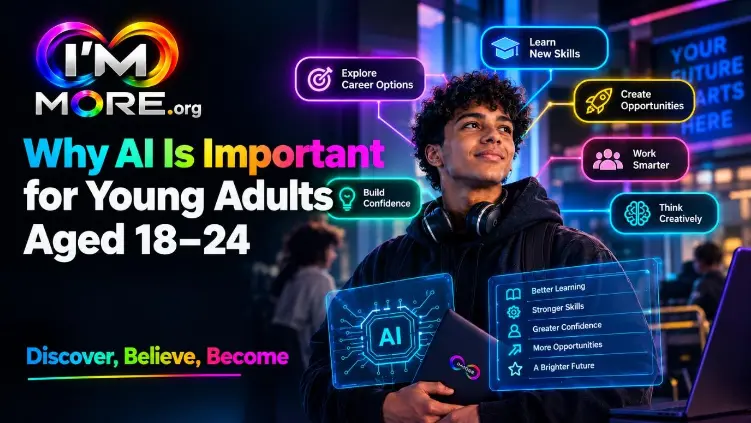
That is one of the reasons artificial intelligence (AI) is becoming increasingly important for young adults aged 18–24.
AI is already being explored across education, business, creative industries and the workplace. Learning how to use it effectively can help young people understand new opportunities, develop their digital skills and approach unfamiliar challenges with greater confidence.
However, AI is not a magic solution. It can make mistakes, provide misleading information and sometimes produce answers that sound convincing without being correct. The real advantage comes from understanding how to use it, when to question it and how to combine technology with your own judgement.
For young adults, the goal is not to let AI decide their future. It is to learn how technology can support the future they want to create.
1. Understand How AI Is Changing the World of Work
The world of work is continually evolving. Businesses are exploring AI to support tasks such as writing, research, customer service, data analysis and planning.
For young adults entering employment, this creates a reason to become familiar with digital tools and understand how they might be used in different industries.
Imagine applying for your first office job. The employer might value your communication skills, reliability and willingness to learn, alongside your ability to use relevant digital tools. Understanding how AI can assist with everyday tasks may help you adapt to new responsibilities.
However, being able to use AI is not a guarantee of employment. Employers still need people who can think independently, work with others, solve problems and take responsibility for their work.
The UK government’s AI Adoption Research provides useful background on how organisations are approaching artificial intelligence.
The important thing is to remain curious about how your chosen industry is changing and identify the skills that will help you contribute.
2. Use AI to Discover Your Strengths and Career Options
Choosing a career can feel overwhelming when you are unsure what you are good at or what direction to take.
AI can help you explore possibilities by suggesting careers linked to your interests, identifying skills you might develop and helping you compare different routes into employment.
For example, someone who enjoys helping people might explore careers in education, healthcare or community services. Someone who enjoys solving problems could investigate technology, engineering or business. A creative person might explore digital design, marketing or content creation.
You could ask an AI tool:
I am 19 and enjoy being creative, working with people and solving problems. Suggest five career paths I could explore, explain the skills each requires and recommend practical ways to gain experience.
The answers can give you a starting point for further research, but they should not determine your choices. AI does not automatically know your full personality, circumstances, values or ambitions.
Use its suggestions to ask better questions, research real opportunities and speak to people with experience in the fields that interest you.
At I’M MORE, we encourage young people to recognise their strengths, discover opportunities and build confidence in their potential.
Your future does not have to be decided in one conversation. Sometimes, progress begins by discovering an option you had never considered.
3. Make Learning Easier and More Accessible
Learning does not stop when you leave school. Whether you are studying for qualifications, completing an apprenticeship or learning independently, developing new knowledge can open doors.
AI can help explain difficult subjects, create practice questions, organise revision and break complicated information into manageable steps.
For example, if you are struggling to understand a topic, you could ask an AI assistant to explain it in simpler language, provide a real-world example and then test your understanding with five questions.
This approach allows you to learn at your own pace and return to subjects that need more attention.
AI can also help you explore skills beyond formal education, including basic coding, business planning, writing, presentation skills and digital marketing.
The OpenAI Academy provides educational resources that can help people learn more about AI and explore practical ways to use it.
However, using AI to produce an answer is not the same as understanding it. Copying work without learning the material can leave you unprepared when you need to apply that knowledge independently.
Use AI to explain, practise and challenge your understanding. Check important information against reliable sources and follow the rules of your school, college, university or training provider.
The aim is to become a stronger learner, not simply to finish a task faster.
4. Build Confidence Before Taking Your Next Step
Confidence can be difficult to develop when you are entering a new environment or facing something unfamiliar.
You might worry about attending an interview, speaking in front of a group, contacting an employer or explaining your strengths to someone you have never met.
AI can provide a low-pressure space to practise these situations before experiencing them in real life.
For example, someone preparing for their first job interview could ask an AI assistant to act as an interviewer. It could ask common questions, review draft answers and suggest ways to communicate more clearly.
You could also practise introducing yourself professionally, preparing questions for an employer or explaining your experience on a CV.
The important part is to practise using your own words. Your answers should reflect your real experiences, achievements and personality rather than sounding like a script written by someone else.
Confidence does not mean never feeling nervous. It means developing the skills and preparation to take action even when something feels unfamiliar.
The Discover. Believe. Become. on-demand training programme is designed to help learners recognise their strengths, build confidence and take practical steps towards employment.
AI can help you prepare, but your confidence grows when you begin applying what you have learned.
5. Turn Your Ideas Into Real Opportunities
Many young adults have ideas they would like to explore but do not know how to get started.
Perhaps you want to launch a clothing brand, create a website, start a social media project or develop a service that solves a problem in your community.
AI can help turn an early idea into a more organised plan.
For example, a young person interested in starting a small clothing business could use AI to:
- Brainstorm potential brand names and themes.
- Identify questions to research about their target customers.
- Draft a basic business plan.
- Explore marketing ideas and social media content.
- Outline the pages needed for a website.
- Create a checklist of tasks for launching the project.
- The first suggestions may not be perfect. You can refine them, compare alternatives and decide which ideas are worth pursuing.
AI cannot guarantee that a business will succeed, and it cannot replace the need to understand customers, manage costs or deliver a quality product.
What it can do is help you move from thinking about an idea to identifying a practical first step.
You do not need to have everything figured out before you begin. Start by testing an idea, learning from the results and improving your approach.
6. Develop Digital Skills That Can Support Your Future
Digital confidence is becoming useful across many areas of life, from education and employment to entrepreneurship and personal projects.
Learning to work with AI can help young adults develop skills that are transferable to different situations.
One useful skill is prompt writing: explaining clearly what you want an AI tool to do. A vague request may produce a generic response, while a more specific request can provide a more useful starting point.
For example, instead of asking, “Help me get a job,” you could say:
Help me create a four-week job-search plan for entry-level customer service roles. Include CV preparation, interview practice, job-search activities and a weekly progress review.
You can improve the result further by explaining your circumstances, preferred working hours and relevant experience, without sharing unnecessary personal or sensitive information.
Other important digital skills include checking information, recognising limitations, protecting personal data and understanding when AI is appropriate for a task.
The UK government’s Skills for Careers – Essential Digital Skills for Work resource offers guidance on developing digital capabilities relevant to employment.
These abilities can help you become more independent and better prepared to learn new technology as it develops.
7. Understand the Importance of Human Skills
As AI becomes more capable, it is easy to assume that technical knowledge is the only thing that matters.
In reality, human skills remain essential. Technology may help generate ideas or organise information, but people still need to understand situations, make decisions and work effectively with others.
Consider a team developing a new product. AI might suggest potential designs or help organise customer feedback, but the team must decide which ideas meet real needs, consider ethical questions and take responsibility for the final result.
For young adults, useful human skills include:
- Communication: Expressing ideas clearly and listening to others.
- Critical thinking: Questioning information and recognising when something does not make sense.
- Creativity: Developing original ideas and finding different approaches to problems.
- Teamwork: Working with people who have different experiences and perspectives.
- Empathy: Understanding other people’s needs and feelings.
- Adaptability: Learning from change and responding to new challenges.
These skills work alongside digital knowledge. You do not have to choose between being good with technology and being good with people.
The National Literacy Trust’s AI and Literacy resources also provide useful perspectives on the relationship between artificial intelligence, literacy and learning.
The strongest approach is to develop both digital confidence and human skills.
8. Use AI Responsibly and Recognise Its Limits
Understanding AI means knowing not only what it can do, but also where it can go wrong.
AI systems can produce inaccurate information, misunderstand instructions or reflect biases in the information used to develop them. They can also raise concerns around privacy, copyright and the appropriate use of generated content.
Young adults should build responsible habits from the beginning.
Check important information. Compare important claims with trustworthy sources, especially when making decisions about education, employment, money or other significant matters.
Protect your personal information. Avoid sharing passwords, financial details, confidential documents or sensitive information with AI tools unless you understand the service and have appropriate permission.
Keep your own judgement. Treat AI responses as suggestions to evaluate rather than instructions you must follow.
Be honest about your work. Follow the rules of your educational institution or employer, and acknowledge AI assistance where required.
Remember that AI is not a person. It can provide information and help you reflect, but it does not have human understanding or replace trusted relationships and professional advice.
Responsible use is part of becoming digitally confident. The goal is to benefit from technology without giving up control of your decisions.
9. Do Not Let the Fear of AI Hold You Back
New technology can create uncertainty. You may wonder whether AI will change the career you want, whether your skills will remain relevant or whether you are already behind because you have not used these tools before.
It is understandable to have questions, but fear alone will not help you prepare.
You do not need to become an expert overnight. Begin with something manageable and build your knowledge gradually.
If you are interested in business, explore how AI can support research or planning. If you are studying, try using it to explain a difficult concept. If you are job hunting, practise interview questions or learn how to improve your CV.
Pay attention to what works, what does not and what you need to learn next.
It is also important to remember that AI will not affect every job or industry in the same way. Different roles require different combinations of technical, practical and interpersonal skills.
Rather than trying to predict every change, focus on becoming someone who can learn, adapt and make informed decisions.
Your starting point does not define your destination. The willingness to develop can be just as important as what you already know.
A Practical Six-Step Plan to Build Your AI Confidence
You do not need an expensive course or a complicated project to begin learning about AI. Start with these six steps.
Step 1: Choose One Goal
Decide what you want AI to help you with. It could be learning a skill, preparing for an interview, exploring a career or developing a creative idea.
Step 2: Ask a Clear Question
Explain what you want to achieve, provide relevant context and ask for the type of answer that would help you.
Step 3: Explore and Practise
Ask follow-up questions, request examples and use the tool to practise the skill rather than simply producing a finished answer.
Step 4: Check the Information
Review the result, verify important facts and question anything that seems unclear or unrealistic.
Step 5: Apply What You Learn
Use the information to take a real step, such as improving a CV, researching a course, practising an interview or testing a business idea.
Step 6: Reflect and Improve
Consider what helped, what you learned and what you would do differently next time. Choose another small goal when you are ready.
Progress does not have to happen all at once. A few practical steps can help you develop a stronger understanding of AI over time.
How I’M MORE Can Support Your Journey
At I’M MORE, our mission is to help young people discover their potential, build confidence and move towards meaningful opportunities.
Whether you are exploring your first career, improving your digital skills or looking for a fresh start, developing confidence and understanding your strengths can make a difference.
Through the Discover. Believe. Become. programme, learners can explore their identity, recognise personal strengths, develop confidence and identify practical next steps towards employment.
You can also visit The Voice to explore more stories, experiences and perspectives from the I’M MORE community.
Learning to use AI is one way to prepare for the future, but it is only part of the journey. Personal development, communication, resilience and real-world experience remain equally important.
The aim is not simply to learn new technology. It is to discover how your abilities, interests and ambitions can help you create opportunities for yourself.
The Future Is Yours to Shape
Being aged 18–24 can mean facing important decisions while still discovering who you are and what you want to achieve.
AI offers new ways to learn, explore careers, develop ideas and prepare for opportunities. Understanding it can help you become more comfortable with technology and more confident when approaching unfamiliar challenges.
But AI alone will not determine your success. Your values, relationships, experiences, creativity and willingness to keep learning all matter.
You do not need to know exactly where your life is heading to take a positive step today. You can begin by exploring an interest, developing a skill or asking a question that helps you see a new possibility.
At I’M MORE, we believe that everyone has potential worth discovering. With the right support, practical opportunities and belief in yourself, you can continue developing the skills and confidence needed to move towards your goals.
Discover what is possible. Believe in your ability to grow. Become the person you want to be.
I’M MORE — Discover. Believe. Become.