
Sometimes, getting started again is the hardest part
It is easy to talk about motivation when everything is going well. It is harder when you have lost your routine, been disappointed by an opportunity or realised you have not done as much as you planned. I am still learning how to handle that side of progress myself.
I have a background in boxing, jiu-jitsu and mixed martial arts, and I am now developing my professional skills through the Youth Guarantee scheme, working primarily on IM MORE. The environments are different, but they have one thing in common: you do not improve simply by thinking about improving. You have to return to the work.
This is not a story about having everything sorted. It is about something I think many people aged 18–24 can relate to: knowing you want to do better, losing momentum sometimes, and wondering how to get moving again without beating yourself up.
The difference between a difficult week and giving up
In a gym, progress is not measured by one perfect session. Training has harder days, technical mistakes and periods when things do not come together. That is not a reason to abandon the whole process. It is a reason to review what needs attention and get back to sensible practice.
I want to bring that mindset into the workplace. If an article needs restructuring, a piece of research is incomplete or I struggle to understand a new task, the useful question is not, ‘Am I just bad at this?’ It is, ‘What exactly needs to change in my next attempt?’
There is an important difference between accountability and constantly criticising yourself. Accountability helps you work out what to do next. Self-criticism without a plan can keep you stuck.
Why starting again can feel embarrassing
When you are young, comparison is everywhere. Maybe someone you know already has a steady job, a car, a qualification or a career plan. Meanwhile, you might still be building a CV or figuring out what work suits you. Having to start again can feel like admitting you are behind.
But learning does not always follow a straight line. You may change direction, need more support or discover that an approach was not working. That is information, not proof that your future is finished.
I am developing different professional skills from those I practised in combat sports: research, writing, SEO, design, planning and communication. I should expect those abilities to take time. So should anybody entering an unfamiliar workplace or trying to secure their first opportunity.
Do not wait for motivation to return
There is a trap in telling yourself you will start again when you feel ready. Sometimes that feeling arrives after you take action, not before. If you are overwhelmed by job searching, you can start by checking one vacancy or improving one paragraph of your CV, rather than trying to change your entire life in a morning.
The National Careers Service recommends keeping your CV clear and tailored to the role. That gives you a specific task you can practise instead of a vague demand to ‘be more employable’.
National Careers Service: How to write a CV
If interviews feel intimidating, you can practise one answer with somebody you trust before attempting a full mock interview. Preparation is a skill, not a personality trait.
National Careers Service: Interview tips
The MMA mindset I want to carry into work
The most useful lesson for me is not about being aggressive or pushing through every problem. It is about disciplined practice: show up, listen, correct, recover and return. A good coach does not make training useful by pretending that mistakes do not exist. Progress requires facing what happened honestly.
At IM MORE, I want to become more independent: research a problem before escalating it, identify where I am unsure, and ask a better question when I need guidance. I want the work I produce to become clearer and more reliable. That comes from habits, not from acting confident all the time.
It also means recognising when to rest or seek support. Professional discipline is not the same as ignoring your wellbeing. Sometimes the sensible next step is to deal with a real obstacle, ask for help or adjust a plan.
Five ways to rebuild your momentum
1. Name what interrupted your progress
Was it a rejection, uncertainty about a task, poor planning, exhaustion or something outside your control? A specific problem is easier to address than the thought that everything is going wrong.
2. Choose a restart small enough to complete
Start with one relevant job application, one section of your CV, one research question or twenty focused minutes on an unfinished task.
3. Put the action in your calendar
“I will do better this week” is difficult to measure. “At 10 am tomorrow I will review three relevant vacancies” is concrete.
4. Keep evidence, not just feelings
Record what you completed, what you learned and what needs another attempt. Your progress should not depend entirely on how confident you feel.
5. Review and adjust without disappearing
If a plan fails, ask why. Change the scale, timing or support available. Then choose your next practical action.
A seven-day IM MORE restart challenge
Day 1: Write down one area of life or work where you want to regain momentum.
Day 2: Identify the smallest useful action and schedule it.
Day 3: Complete that action and record what happened.
Day 4: Ask for constructive feedback or investigate what you do not understand.
Day 5: Repeat the action or improve it based on what you learned.
Day 6: Take care of a practical barrier: your timetable, transport, materials or support.
Day 7: Review your progress and choose your next seven-day goal.
You are not back at zero
When you start again, you bring everything you have learned with you: the attempts that did not work, the skills you have practised and the insight you gained by trying. An unsuccessful application may teach you to tailor your CV. A difficult conversation may show you how to prepare. A training setback may reveal which skill needs attention.
For young people who are anxious about the future, the NHS offers practical suggestions for breaking worries into problems you can act on and concerns outside your control. That distinction helps prevent reflection from turning into endless overthinking.
NHS Every Mind Matters: Tackling your worries
My opportunity with IM MORE is part of learning how to bring the determination I know from sport into a new setting. I want to keep building the skills that make me useful, dependable and employable. That does not require a perfect record. It requires ownership of my next step.
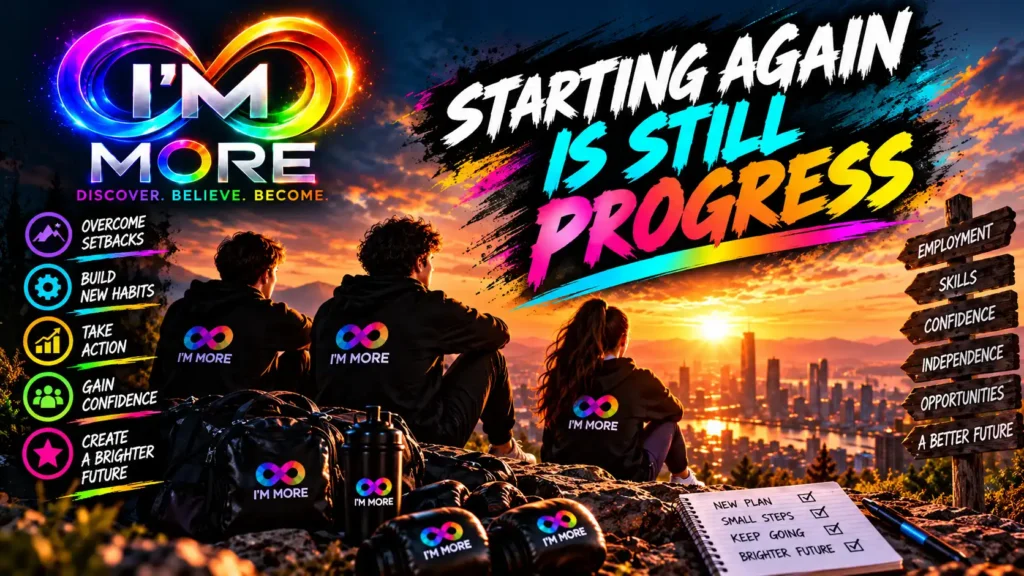
If you are starting again after a frustrating period, do not spend all your energy wishing you had begun earlier. Decide what you can do now. Starting again is still progress.
IM MORE — Discover. Believe. Become. Explore IM MORE