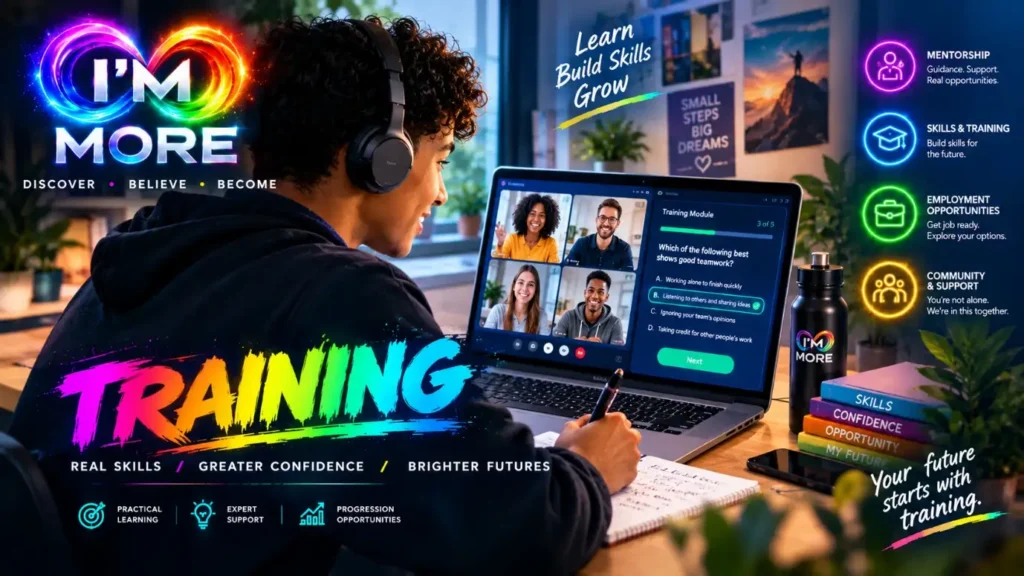
Introduction: More Than a Job, a Brighter Future
NEET youth training programmes play an important role in helping young people develop confidence, build employability skills and prepare for future employment opportunities. All Young people deserve the opportunity to discover their strengths, develop valuable skills and build a future they can feel proud of. Yet, for many young adults aged 18–24, the journey from education into employment is not straightforward. Uncertainty, a lack of experience, low confidence, limited opportunities and personal challenges can make it difficult to know where to begin.
For young people who are not in education, employment or training (NEET), the challenge can be particularly difficult. Some may have left school without the qualifications they hoped for. Others may have struggled to find work, experienced setbacks, lost motivation or found that traditional education does not suit their learning style. Many have abilities and ambitions that have not yet been recognised or developed.
At I’M MORE, our message is simple: you are more than your circumstances, more than your past experiences and more than the opportunities you have or have not received so far.
Through our Discover. Believe. Become. approach, we aim to help young people recognise their potential, develop practical and personal skills, build confidence and take meaningful steps towards employment and a brighter future.
Our approach is about more than completing training. It is about helping young people become more confident, capable and prepared to participate in the world of work. By combining personal development, practical learning, mentorship, engagement and employment-focused support, I’M MORE seeks to make the journey towards a positive future more accessible.
Understanding the Challenges Facing Young People Who Are NEET
The term NEET describes young people who are not currently in education, employment or training. It is a description of someone’s current circumstances, not a judgement about their ability, character or potential.
The scale of the challenge is significant. According to the Department for Education’s NEET statistics for England, an estimated 16% of 18–24-year-olds in England were NEET in October to December 2025. The figures underline the importance of effective support that helps young adults access learning, training and employment opportunities.
However, statistics only tell part of the story. Behind every number is an individual with their own experiences, ambitions, responsibilities and barriers.
Some young people may lack confidence after repeated rejection from employers. Others may have limited access to professional networks, suitable equipment, transport or reliable careers advice. Some may need additional support with mental health, disability, caring responsibilities or other personal circumstances.
There is no single explanation for why a young person becomes NEET, and there is no single solution that works for everyone.
This is why I’M MORE places importance on understanding the individual, building positive relationships and creating opportunities for young people to develop at a pace that supports their progress.
Our aim is not simply to ask, “Why aren’t you working?” It is to explore more useful questions: “What are you good at? What would you like to achieve? What is holding you back? What support would help you take your next step?”
These questions create the foundations for a more constructive, personalised approach to employability.
The I’M MORE Philosophy: Discover. Believe. Become.
The Discover. Believe. Become. framework provides a clear way to understand the journey from uncertainty towards greater confidence, skills development and employment readiness.
Each stage builds on the previous one. Young people first explore their strengths and interests, then develop belief in their ability to progress, before applying what they have learned to practical goals and opportunities.
-
DISCOVER: Recognising Strengths, Interests and Possibilities
The first step is discovery. Before young people can confidently plan their future, they need opportunities to understand themselves, explore their interests and identify the skills they already possess.
Some may believe they have little to offer an employer because they lack formal work experience or qualifications. Yet valuable abilities can be developed through everyday life, volunteering, hobbies, caring responsibilities, teamwork, community involvement and personal challenges.
The Discover stage encourages young people to look beyond what they think they cannot do and begin identifying what they can do, what they enjoy and what they would like to learn.
What the Discover stage can deliver
Self-awareness and personal strengths
Young people can explore their interests, motivations, values and existing abilities. Guided discussions, reflective activities and practical exercises can help them recognise qualities such as reliability, creativity, problem-solving, communication and perseverance.
Recognising these strengths can provide a starting point for setting realistic goals and identifying suitable career pathways.
Career exploration
Discovering potential also means exploring the world of work. Young people can learn about different industries, job roles, entry requirements, apprenticeships, vocational training and alternative routes into employment.
The National Careers Service provides information about careers, skills assessments, job profiles and training options. Incorporating reliable careers information into employability support can help participants make informed choices rather than feeling pressured to follow a path that does not suit them.
Understanding transferable skills
A young person may not have worked in an office, warehouse, hospitality setting or customer-service role, but they may already possess relevant transferable skills.
For example, organising a community activity can demonstrate planning and communication. Helping care for a family member may involve responsibility, time management and problem-solving. Participating in a team activity can develop cooperation and accountability.
The Discover stage can help participants identify these abilities and understand how to explain them to prospective employers.
Setting achievable goals
Discovery should lead to action. Each participant can begin developing a personal plan that identifies their interests, immediate priorities, longer-term ambitions and the support they may need.
For one young person, the next step may be improving digital skills. For another, it may be preparing a CV, exploring an apprenticeship or rebuilding the confidence to attend an interview.
The objective is to make the future feel more understandable and achievable.
-
BELIEVE: Building Confidence, Motivation and Resilience
Recognising potential is important, but young people also need to believe that they can develop it.
Repeated setbacks can affect confidence. Rejection from employers, difficulties in education or negative experiences can lead some young adults to doubt their abilities or assume that further effort will not make a difference.
The Believe stage focuses on helping participants develop a stronger sense of self-worth, recognise their progress and understand that skills and confidence can grow through practice.
What the Believe stage can deliver
Confidence and self-belief
Confidence grows when people have opportunities to try something new, receive constructive feedback and recognise their progress.
Training activities can provide manageable challenges that allow young people to practise communication, teamwork, decision-making and presenting their ideas. Completing these activities can help them recognise that they are capable of learning and improving.
Rather than expecting participants to become confident overnight, the emphasis should be on steady progress.
Communication and interpersonal skills
Employers need people who can communicate clearly, listen to others, ask questions and work constructively with colleagues.
The Believe stage can support these abilities through group discussions, role-play, collaborative activities and guided reflection. Participants can practise expressing their opinions, listening respectfully, receiving feedback and resolving misunderstandings.
These experiences are particularly valuable for young people who feel anxious about interviews, meeting new people or entering unfamiliar environments.
Resilience and responding to setbacks
Employment journeys rarely follow a perfectly straight line. Applications may be unsuccessful, interviews may not lead to offers, and training can involve difficult tasks.
Young people benefit from understanding that setbacks do not define their future. They can learn to reflect on what happened, identify what can be improved and decide on their next action.
Resilience does not mean ignoring difficulties or expecting individuals to overcome every barrier alone. It means developing constructive ways to respond while recognising when additional support is needed.
Mentorship and positive role models
Mentorship can be an important part of building belief. A supportive mentor can listen, encourage realistic ambition, help a young person identify options and provide constructive guidance when challenges arise.
Through its mentoring-focused approach, I’M MORE can help participants feel that their progress matters and that asking for help is a positive step rather than a sign of weakness.
Mentorship should be built around trust, appropriate boundaries and achievable goals. It is most valuable when young people are encouraged to make their own decisions, recognise their achievements and gradually take greater responsibility for their progress.
Belonging and peer support
Learning alongside others can help participants realise that they are not alone in facing uncertainty. Group activities create opportunities to share experiences, practise collaboration and encourage one another.
A welcoming environment can help young people feel comfortable asking questions and making mistakes without being embarrassed.
For I’M MORE, building confidence means creating opportunities for participants to experience progress, belonging and personal achievement.
-
BECOME: Turning Skills and Confidence into Employment Opportunities
The Become stage focuses on applying what young people have discovered and developed to real-world goals.
Confidence is important, but young people also need practical tools, relevant skills and clear routes towards employment, further learning or vocational training.
The objective is to help participants move from preparation towards action.
What the Become stage can deliver
Employability skills
Young people can develop practical skills that employers commonly expect, including punctuality, reliability, teamwork, communication, problem-solving, organisation and professional conduct.
Training activities can help participants understand how these behaviours apply in different workplaces. For example, a group project can demonstrate the importance of meeting deadlines, sharing responsibilities and communicating when problems arise.
CV writing and job applications
Participants can learn how to create a clear CV, identify relevant experience, describe transferable skills and tailor applications to individual vacancies.
They can also practise completing application forms, writing professional emails and presenting their achievements accurately.
For young people with limited formal employment history, this is an opportunity to recognise the value of volunteering, community participation, personal projects and other relevant experiences.
Interview preparation
Interviews can be intimidating, particularly for applicants who have little experience or low confidence.
Practice interviews, example questions and constructive feedback can help participants prepare answers, explain their strengths and communicate their interest in a role.
They can also learn about appropriate interview preparation, researching employers, asking relevant questions and following up professionally.
Digital and workplace readiness
Many recruitment processes and workplaces require basic digital confidence. Depending on each participant’s needs and the training available, development may include using email, searching for vacancies, completing online forms, creating documents and using digital tools safely and professionally.
Practical exercises can help participants become more comfortable with the technology involved in job searching and everyday work.
Exploring employment and training routes
Not every young person will move directly into a permanent job. Some may benefit from an apprenticeship, a traineeship or other available vocational learning, a further-education course, volunteering or an entry-level opportunity.
The GOV.UK apprenticeships service explains how people can search and apply for apprenticeships in England. Participants can use such resources to explore routes that combine learning with practical experience.
The Become stage should help each participant identify an appropriate next step rather than treating immediate employment as the only acceptable outcome.
Exploring I’M MORE’s Wider Training and Development Offer
Discover. Believe. Become. provides a framework for personal and professional progression. It can also connect the different elements of I’M MORE’s wider approach to youth engagement and employability.
The following areas describe how the training themes presented by I’M MORE can support young people. The precise modules, course durations, qualifications and delivery arrangements should be confirmed against the programme currently offered.
Skills and employability training
Practical skills training helps bridge the gap between wanting a job and being ready to pursue one.
Sessions can focus on communication, teamwork, problem-solving, digital confidence, workplace expectations, CV preparation and interview techniques. Activities should be practical and relevant to the opportunities participants are exploring.
The value lies in helping young people practise skills, receive feedback and understand how to apply what they learn.
Mentoring and personal development
Mentoring complements skills training by providing encouragement, reflection and guidance.
A mentor can help a participant set goals, review progress, identify obstacles and maintain motivation. Regular conversations also provide opportunities to recognise small achievements that might otherwise be overlooked.
Mentoring should complement, rather than replace, specialist support where a young person needs professional help with health, wellbeing, housing or other complex circumstances.
Employment opportunities and career pathways
Training becomes more meaningful when participants can see how it connects to real opportunities.
I’M MORE can support this connection by helping young people research vacancies, prepare applications, understand employer expectations and explore local opportunities. Where appropriate, engagement with employers can help participants understand different industries and the skills they require.
Workplace visits, employer talks, volunteering opportunities, work experience and introductions to relevant providers may also help participants gain a clearer picture of employment.
Any placements, employer partnerships or job opportunities should be described accurately according to what I’M MORE has actually arranged.
Personal growth and life skills
Sustainable progress towards employment may depend on more than occupational skills.
Young people may benefit from developing time management, organisation, decision-making, confidence, communication and the ability to manage everyday responsibilities.
For some participants, these capabilities can make it easier to attend training regularly, meet deadlines, prepare for interviews and manage the transition into work.
The purpose is not to expect every young person to overcome every difficulty independently. It is to help them build practical capabilities while identifying the support they may need.
Keeping Young People Engaged: What I’M MORE Can Do Differently
A training programme can offer valuable content, but it cannot make a difference if participants do not feel able to engage with it.
Young people who have experienced setbacks may be cautious about joining another programme. Some may have had negative experiences of education or training, while others may struggle with confidence, inconsistent routines or barriers that make regular attendance difficult.
Keeping participants engaged therefore requires a thoughtful combination of relationships, relevant learning, flexibility and visible progress.
-
Create a welcoming, non-judgemental environment
The first experience matters.
Young people should be welcomed as individuals rather than defined by their NEET status. Staff and mentors can take time to understand their interests, concerns, ambitions and preferred ways of learning.
A respectful environment encourages participants to ask questions, admit when they need help and try activities without fearing embarrassment.
The message should be clear: everyone has something to contribute, and everyone can make progress.
-
Make training practical, interactive and relevant
Long periods of passive instruction may not meet every learner’s needs. Interactive activities can make learning more accessible and help participants understand why a skill matters.
For example, participants might work together on a project, practise an interview, create a CV, solve a workplace scenario or prepare a short presentation.
Activities should connect directly to the skills and situations young people may encounter in employment.
Where possible, trainers can offer different ways to participate, including discussion, demonstration, practical exercises and individual reflection.
-
Build relationships through mentoring and regular contact
Consistent relationships can help participants feel supported and accountable.
A mentor or programme contact can check in on progress, discuss difficulties and help a young person identify the next manageable action. If attendance drops or motivation changes, a supportive conversation may reveal an obstacle that can be addressed.
The aim should be to understand what is happening rather than immediately assuming a participant is uninterested.
Regular contact must be proportionate, respectful of privacy and consistent with the programme’s safeguarding and data-protection arrangements.
-
Break goals into achievable steps
A long-term ambition such as becoming employed can feel overwhelming when someone is unsure where to start.
Breaking that ambition into smaller milestones can make progress more visible.
One participant might begin by attending an introductory session, then complete a skills assessment, prepare a CV, practise an interview and apply for a suitable vacancy.
Another might need to focus first on confidence, digital skills or identifying an appropriate learning route.
Recognising these milestones helps participants see evidence of their development, even when the final outcome takes time.
-
Celebrate progress and effort
Recognition can reinforce motivation when it is specific, genuine and connected to personal growth.
Instead of simply saying, “Well done,” a trainer might acknowledge that a participant has become more confident speaking in a group, completed an application independently or supported another learner during a team activity.
Progress should not be measured only by qualifications or job offers. Improved attendance, communication, confidence, practical skills and readiness for further learning can also be meaningful steps.
Celebrating progress does not mean lowering expectations. It means recognising that different participants may need different routes to reach their goals.
-
Listen to young people’s feedback
Engagement improves when participants have opportunities to influence their learning experience.
I’M MORE can invite feedback about activities, delivery methods, barriers to attendance and the kinds of support young people find useful.
Short feedback conversations, anonymous surveys and regular progress reviews can help identify what works and what needs improvement.
Young people can also be invited to suggest future topics, discuss their career interests and reflect on which activities have helped them most.
This approach helps ensure that training remains relevant rather than assuming that the same format will suit everyone.
-
Connect training with real opportunities
Young people are more likely to recognise the value of training when they understand how it relates to their ambitions.
Explaining which skills employers seek, introducing credible careers resources and helping participants identify appropriate vacancies can connect learning with practical outcomes.
The National Careers Service and GOV.UK Find a Job provide resources that can support career exploration and job searching.
Where available, employer engagement and work-related activities can strengthen this connection further.
-
Recognise barriers and signpost appropriate support
Sometimes a young person’s difficulty attending or completing training has little to do with the training itself.
Transport costs, caring responsibilities, disability, mental-health challenges, housing insecurity and digital exclusion can all affect participation.
A supportive programme should provide clear information about available assistance, consider reasonable adjustments where applicable and signpost participants to relevant services.
Not every barrier can be resolved by a training provider, but listening carefully and helping a young person find appropriate support can make a meaningful difference.
Measuring Progress: How We Can Understand What Is Working
A strong youth employability programme should aim to demonstrate its value through meaningful evidence, not just positive intentions.
For I’M MORE, useful measures may include attendance, participation, completion of planned activities, progress against personal goals, skills development, confidence, CV completion, interview preparation and applications made.
Where participants consent and appropriate follow-up arrangements exist, the programme can also track progression into employment, apprenticeships, further education, vocational training or other relevant opportunities.
These measures help distinguish between activities delivered and outcomes achieved.
For example, the number of young people attending a session tells us about participation. It does not, by itself, demonstrate that their skills improved or that they moved closer to employment.
Combining attendance data with participant feedback, progress reviews and longer-term outcomes can provide a more complete picture.
Results should be reported honestly. Job outcomes may depend on factors beyond a programme’s control, including local vacancies, employer requirements and individual circumstances. Tracking these influences helps I’M MORE identify where its support is effective and where additional partnerships or resources could help.
Working Towards a Brighter Future
Supporting young people who are NEET requires patience, consistency and a belief that people can develop beyond their current circumstances.
Discover. Believe. Become. offers a way to organise that journey. Discover helps young people identify strengths and possibilities. Believe supports confidence, resilience and motivation. Become helps translate learning into practical skills, informed decisions and steps towards employment.
Combined with mentoring, relevant training, supportive relationships, community engagement and connections to opportunities, this approach can help young people build a stronger foundation for their future.
For I’M MORE, success should mean more than encouraging young people to find a job. It should mean helping them develop the skills, confidence and self-awareness to make informed decisions, pursue realistic ambitions and continue learning as their circumstances change.
Every participant will have a different starting point. Some may move quickly into work, while others may need more time, further training or additional support. Both journeys deserve to be approached with respect and realistic encouragement.
The message behind I’M MORE remains at the heart of this work: young people are more than their setbacks, more than their current circumstances and more than the opportunities they have encountered so far.
By helping them Discover their potential, Believe in their ability to grow and Become better prepared for the future, I’M MORE can contribute to a more confident, skilled and connected generation of young adults.
To learn more about I’M MORE and its approach, visit immore.org and explore how Discover. Believe. Become. can support the journey towards personal development, skills and employment.
Discover. Believe. Become. Because every young person deserves the opportunity to move forward.