

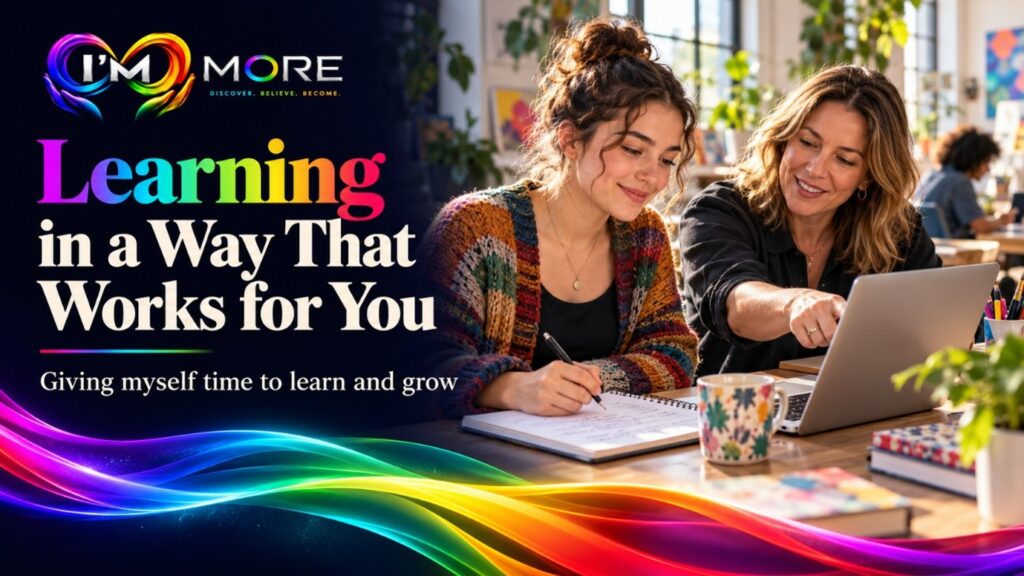
Learning in a way that works for you can make a real difference when you’re trying to rebuild confidence after a difficult experience with education.
When I left college with hardly any qualifications, it was difficult to separate my results from how I felt about myself. I worried about my future and questioned what I was capable of. I knew I wanted to move forward, but the thought of having to learn something new could bring its own worries. What if I struggled again? What if I asked a question that everyone else already knew the answer to? For more encouragement, explore I’M MORE’s article on asking for help at work.
Looking back, I wish I had understood that leaving education didn’t mean my opportunity to learn had ended. There were still things I could explore, skills I could practise and people I could ask for support. I didn’t have to have everything worked out before giving myself another chance.
Through my work at I’M MORE, learning is becoming part of the things I do each day. Writing articles, thinking of social media ideas and helping develop training content all give me something to work on. They also give me a reason to learn. I am thinking about how to express an idea, explain an experience or create something that could help another young person.
Writing about my own life is one example. I know what it felt like to leave college unsure of my next step, but putting those feelings into an article takes work. I need to decide where to begin, how to organise my thoughts and what I want the reader to understand. Having something personal to say gives me a starting point, even when I need help with the wording.
Asking for support with paragraphs, spelling or grammar is part of that process. It gives me an opportunity to look at how my ideas can become clearer. I want to give myself time to understand the changes too, so that I can use what I learn in the next piece of writing.
For me, learning in a way that works means being able to say when I need something explained. That can feel uncomfortable when I want to show that I am capable. I have spoken before about wanting to feel able to express myself without worrying about what someone might say. That matters when I am sharing an idea, and it matters just as much when I don’t understand something.
A question such as “Could you show me an example?” or “Can we go through that first part again?” can give me a way forward. I don’t need to apologise for wanting to understand a task properly. I want to become more comfortable asking those questions before worry takes over.
I am also thinking about how to make unfamiliar tasks feel more manageable. With an article, I can begin by writing down the main point rather than expecting myself to produce a finished piece straight away. Then I can work on an introduction, build the paragraphs and check whether they say what I mean. Each part gives me something specific to focus on.
There are different approaches I can try depending on the task. I might read an example, talk an idea through, make a few notes or practise a small part before attempting the whole thing. I am still discovering which combinations help me. I don’t need to decide that I can only learn in one particular way. The National Careers Service offers guidance on developing your skills, including learning through courses, work and independent activities.
Feedback is another part of learning that I want to use well. When I have put effort into something personal, being told it needs changing can feel difficult. But a clear explanation can help me understand what to do next. Knowing that a paragraph needs more detail, or that a sentence is unclear, gives me a task I can act on.
I want to learn how to notice improvement as well as mistakes. If I explain an idea more clearly than I did before, that matters. If I understand a correction and apply it to another article, that matters too. Keeping track of those small changes could help me see progress that I might otherwise overlook. You can also explore how to recognise your strengths and build new skills.
This also affects the ideas I want to bring to I’M MORE’s training content. I know what it feels like to be unsure of yourself, so I want to think about how an activity might feel to someone taking part for the first time. Do they understand what they are being asked to do? Have they seen an example? Is there space to ask a question or practise before sharing their answer?
For some activities, we could offer a choice between writing an answer, discussing it with someone or demonstrating it through a practical task. Where speaking or presenting is the skill being developed, we could build towards it gradually. I would like our ideas to help people participate while still giving them opportunities to stretch themselves.
Discover, Believe and Become connects with this for me. I can explore what helps me understand a task, build confidence through practice and use what I have learned in my work. There will still be moments when I feel unsure, but I can begin to recognise what support I need and what I can try next.
If you have left education feeling disappointed or worried about your abilities, I understand why starting again might feel difficult. My own experience has made me want to give learning another chance. That might begin with one question, one short activity or one conversation about something you would like to do.
I am still learning how to write, share ideas and express myself. I don’t have to hide that. The next time I find something difficult, I want to pause and ask what would help me take the next step. I owe myself the opportunity to find out what I can do with time, practice and support.













