

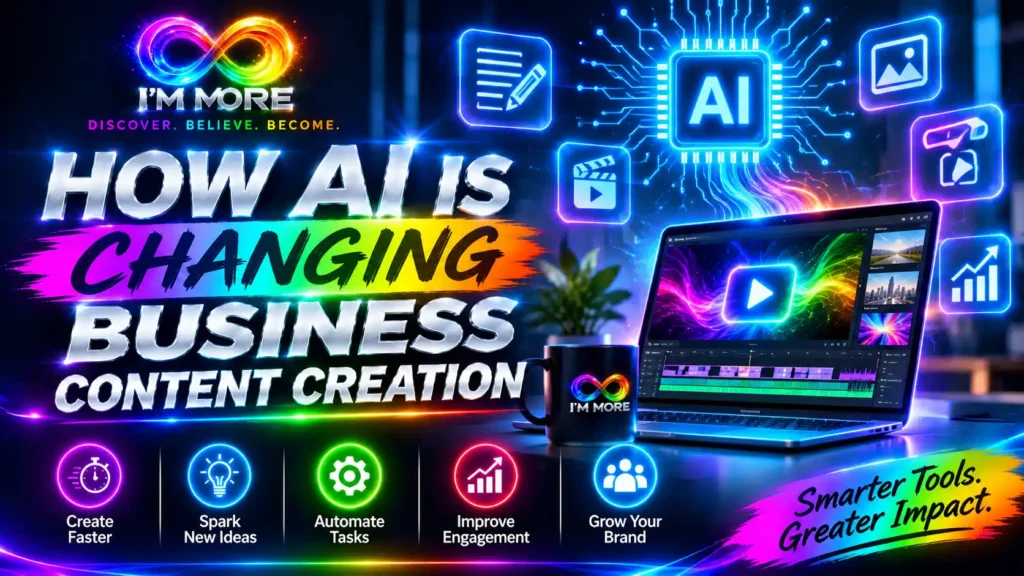
How AI Is Changing Business Content Creation
Every business needs content. It helps people discover a brand, understand what it offers and decide whether they trust it. But creating strong content takes time. Businesses need website pages, blog articles, emails, product descriptions, videos, graphics and social media posts—and each one needs to feel relevant and consistent.
Artificial intelligence is changing how that work gets done. Tools powered by generative AI can help teams brainstorm ideas, draft copy, create images, edit videos, analyse performance and adapt messages for different audiences. Tasks that once took hours can sometimes be completed in minutes.
That does not mean businesses can simply press a button and expect brilliant content. The strongest results come when AI supports human creativity rather than replacing it. The opportunity is not just to make more content; it is to make better use of time, ideas and insight.
1. From blank page to first draft
One of the biggest challenges in content creation is getting started. A business might know it needs a blog post or a month of social media updates but struggle to find the right angle. AI can help turn a rough idea into a workable starting point. For more on the creative opportunities, read Can AI Unlock Creativity in Business? and explore how AI can support fresh thinking without taking over the creative process.
A user can ask an AI assistant to suggest article headlines, create an outline, generate interview questions, organise research notes or produce a first draft. It can also rewrite a paragraph for a different reading level, suggest clearer wording or turn a long explanation into a short social caption.
This is especially useful for small businesses where one person may be responsible for marketing alongside many other jobs. AI can reduce the time spent on repetitive early-stage tasks, leaving more room for planning, customer conversations and creative decisions.
However, a first draft is only a beginning. AI may misunderstand a brief, repeat familiar ideas or present incorrect details with confidence. A person still needs to check facts, add original experience and decide whether the writing genuinely helps the intended reader.
2. Creating content for more channels
A single business message often needs to appear in several places. A new product launch, for example, might require a website announcement, an email, a blog post, a short video script and a series of social posts. This connects with the ideas in From Idea to Innovation: Using AI to Develop New Products, where AI is explored as a tool for developing and shaping new ideas.
AI can help adapt the central message for each format. It can shorten a long article into a LinkedIn post, suggest a sequence of Instagram captions, turn product information into a video script or create alternative headlines for testing. This makes it easier to keep communication moving across channels without starting from zero each time. For more on this creative process, explore Can AI Unlock Creativity in Business? and HubSpot’s guide to AI in content marketing.
The important point is to adapt—not simply copy and paste. Each platform has its own audience, pace and style. A detailed website guide should not read like a quick social update, and a customer email should not sound like an advertisement. Human review helps make sure every version feels natural and fits the channel.
3. Making visual content easier to produce
Business content is no longer just about words. Images, illustrations, presentations, short-form videos and product visuals all play a major role in how a brand communicates.
AI-powered creative tools can help generate visual concepts, remove backgrounds, resize designs, create variations and speed up editing. They can be useful when a team needs to explore several directions before choosing a final look. A small business may be able to develop a wider range of campaign ideas without needing to produce every early concept from scratch. Research such as Adobe’s Creators’ Toolkit Report also highlights the growing role of creative technology in content workflows.
Yet visual quality and brand consistency still matter. AI-generated images can contain strange details, misleading representations or elements that do not match a product. Businesses should check that visuals are accurate, appropriately licensed for their intended use and consistent with their brand identity. For products, people and real-world services, never let an attractive image create a false impression.
4. Making content more relevant to customers
Different customers care about different things. A new customer may need a simple introduction, while an existing customer may want detailed advice or information about a new feature.
AI can help businesses organise customer feedback, identify recurring questions and explore patterns in content performance. When used with appropriate, permissioned data, it can also support more tailored messages for different audiences. This can make communication more useful and less generic. The UK Government’s AI adoption research also provides useful wider context on how organisations are adopting AI.
Personalisation needs care. Businesses should respect privacy, follow data-protection requirements and avoid using sensitive information in ways customers would not expect. A message should feel helpful, not intrusive. The best personalisation starts with understanding what people need—not simply inserting someone’s name into an automated email.
5. Helping smaller businesses compete
Large organisations often have dedicated writers, designers, video teams and marketing departments. Smaller businesses may have a much tighter budget and fewer people to share the workload.
AI can help narrow that gap by making certain tools and capabilities easier to access. An independent business can use AI to plan a content calendar, draft a frequently asked questions page, explore campaign concepts or prepare several versions of a product description. This does not remove the need for expertise, but it can help a small team make better use of the resources it has. This connects with wider findings in the UK Government’s AI adoption research, which explores how organisations are adopting AI.
The advantage will not come from publishing the highest number of posts. It will come from understanding customers, having a clear point of view and using tools to deliver useful information consistently.
6. The risks businesses need to understand
AI brings real opportunities, but using it without a process can damage trust. Common risks include inaccurate information, generic writing, bias, copyright concerns, privacy problems and content that sounds unlike the brand. For practical guidance, see Google’s guidance on generative AI content, which explains why useful, people-first content matters more than publishing pages at scale.
Search visibility is another area where quality matters. Google’s guidance explains that generative AI can be useful for research and structure, but producing large numbers of pages without adding value can fall foul of its scaled-content-abuse policies. The goal should be helpful, reliable and original content—not mass production for its own sake. Businesses can read Google’s guidance on generative AI content for more detail on creating helpful, people-first pages.
Businesses should also be clear about responsibility. Someone needs to own the final result, verify claims, check sources, review visuals and make sure the content meets legal and industry requirements. For important subjects such as finance, health, safety or legal services, qualified human review is essential.
7. Why the human voice matters more than ever
As AI makes content easier to produce, the internet can become even more crowded. That makes a recognisable human voice more valuable, not less. For a closer look at the value people bring, see Human Skills and Artificial Intelligence: Why Businesses Need Both.
People connect with stories, opinions, experiences and details that feel real. AI can help shape a story, but it cannot replace a founder explaining why they started a business, a team sharing what they learned from a project or a customer describing how a product helped them.
Human creativity also provides direction. People decide which ideas are worth pursuing, what a brand stands for, what tone feels right and what should never be published. AI can offer possibilities; people bring purpose, empathy and judgement.
For a growing business, the strongest approach is to use AI for speed and support while keeping real people at the heart of the message.
8. A practical way to introduce AI into your content process
Businesses do not need to change everything at once. A simple, controlled starting point can reveal where AI is genuinely useful: For another practical perspective on turning ideas into action, read From Idea to Innovation: Using AI to Develop New Products.
- Choose one repetitive task. Start with something manageable, such as brainstorming headlines, summarising internal notes or adapting an approved article into social posts.
- Set clear brand guidelines. Give the tool examples of the brand’s tone, audience, preferred language and phrases to avoid. Do not share confidential information unless the tool and organisation are approved for that use.
- Give specific instructions. Explain the audience, purpose, format, key points and desired action. Better direction usually produces more useful results.
- Check every output. Verify facts, dates, statistics, quotations, links, image details and claims. Rewrite anything generic or inaccurate.
- Measure the outcome. Look beyond how quickly content was produced. Track useful measures such as engagement, enquiries, conversions, customer questions and time saved.
- Keep learning. Review what works, update the process and make sure people remain responsible for the final content.
The future of business content is human and AI working together
AI is changing business content creation by making it faster to explore ideas, produce drafts, adapt messages and develop visual assets. It gives businesses new ways to work, particularly when time, skills or budgets are limited.
But technology alone does not create a strong brand. Trust comes from accuracy, originality, consistency and a genuine understanding of the people a business wants to reach. Those qualities still depend on human decisions.
The businesses that make the most of AI will not necessarily be the ones that automate everything. They will be the ones that know where AI adds value, where human judgement is essential and how to combine both without losing what makes their voice distinctive.
The future is not about choosing between people and technology. It is about using technology to give people more space to think, create and connect.













