

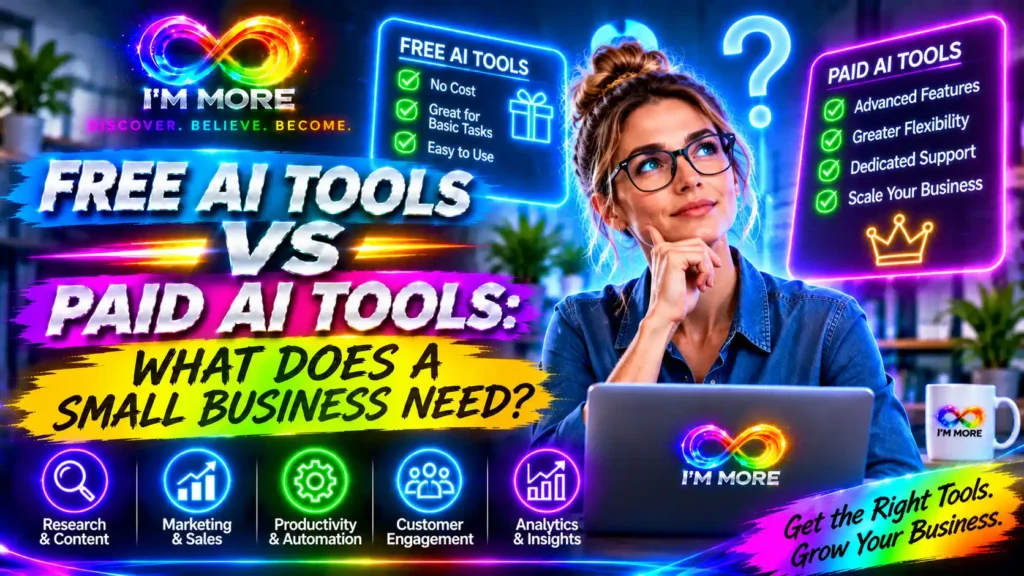
Introduction: Do you really need to pay for AI?
Artificial intelligence is becoming part of everyday business life. It can help write emails, plan social media, summarise information, organise ideas, research competitors and support customer service. For a small business, that can feel like an opportunity to get more done without immediately hiring extra help.
But there is a question behind every new tool: should you use the free version, or pay for a subscription?
The good news is that a small business does not automatically need a collection of paid AI tools. Free plans can be genuinely useful, especially when you are learning what AI can do. Paid plans may become worthwhile when you use a tool regularly, reach its limits or need features that make a measurable difference.
The right decision is not about choosing the most expensive technology. It is about choosing the simplest option that safely solves a real business problem.
1. What can free AI tools do for a small business?
Free AI tools are a sensible starting point for businesses that want to experiment without committing to another monthly cost. Depending on the provider and current plan limits, they may help with:
Writing and editing: drafting emails, product descriptions, website copy, proposals and social media captions.
Ideas and planning: brainstorming campaign themes, outlining a blog article or turning a rough idea into an action plan.
Research and summarising: getting an initial overview of a topic, summarising public information or preparing questions for further research.
Creative support: exploring image concepts, presentation ideas and simple marketing content.
Everyday problem-solving: explaining unfamiliar terms, creating checklists or helping structure a process.
For example, a local shop could use a free AI assistant to draft a seasonal promotion. A tradesperson could ask it to make a customer email clearer. A consultant could use it to turn meeting notes into a first draft of an action list. These are useful tasks, and they do not necessarily require a paid subscription.
There are several places to begin. The ChatGPT plans page explains the features and limits associated with its available plans. Google’s UK Gemini plans page shows its free and paid options. Microsoft also explains the distinction between free Microsoft Copilot and Microsoft 365 Copilot.
2. What do paid AI tools offer?
Paid AI plans are generally designed to provide more capacity, additional features or a more integrated way of working. The exact benefits vary by provider, product and subscription, so it is important to compare the plan details rather than assume every paid tool offers the same things.
Higher usage limits: more messages, file uploads, image creation or research activity before you reach a limit.
More capable features: access to additional models, advanced analysis, larger context windows or specialist tools.
Workflow integration: AI features built into the software your business already uses, such as documents, spreadsheets, email or collaboration tools.
Team and administration options: shared workspaces, central billing, user management or business-oriented controls where offered.
Time savings at scale: the ability to handle recurring tasks more consistently or process larger amounts of information.
Imagine you prepare proposals every week. A free tool might be enough to draft occasional wording. If you are regularly analysing long documents, revising multiple versions and working with a team, a paid plan with suitable capacity and collaboration features could save enough time to justify its cost.
However, a paid subscription does not guarantee accurate answers, better decisions or a finished piece of work. Human review is still essential. AI can misunderstand instructions, invent details or produce content that sounds convincing but is wrong.
3. Free vs paid: the key differences
| Area | Free tools | Paid tools |
| Cost | No subscription fee, but limits may apply. | Recurring cost; check monthly and annual pricing. |
| Usage | Often suitable for occasional tasks. | Usually offers higher limits or broader access. |
| Features | Core functions may be enough for everyday work. | May include advanced tools and integrations. |
| Teamwork | May be designed mainly for individual use. | Some plans add shared workspaces and admin controls. |
| Best fit | Testing, learning and low-volume tasks. | Frequent, valuable or team-based workflows. |
This is a general guide, not a promise about every provider. Features and limits change, and some products offer free trials, usage-based billing or different business plans. Always check the provider’s current terms before making a purchase.
4. When should a small business stay with free AI?
Stay with free tools when you are still discovering where AI fits into your business. If you only use it once or twice a week, the free allowance may be enough. It may also be the better choice when:
You are experimenting with prompts and learning how to check AI-generated work.
Your tasks are short, straightforward and do not regularly hit usage limits.
You have not yet identified a repeatable business process that AI improves.
You can complete the work comfortably with the free features already available.
Your budget is tight and the subscription would compete with more important business costs.
There is no business advantage in paying for a tool simply because other companies are using it. If a free option does the job reliably and safely, keeping the money in your business may be the smartest decision.
5. When is it worth upgrading to a paid tool?
Consider paying when you can point to a clear limitation or opportunity. Perhaps you regularly run out of messages, need to work with larger files, want a feature that is not included in the free plan or need a managed workspace for several employees.
The strongest reason to upgrade is measurable value. If a subscription costs £20 per month, for example, ask whether it saves enough staff time, reduces avoidable work or helps generate additional revenue to justify that amount. The example is illustrative: actual prices vary by provider, plan, location and billing method.
A simple calculation can help:
Monthly value = time saved × the realistic value of that time + other measurable benefits − subscription and setup costs
Be realistic. Time saved is only valuable if it can be used productively. A tool that creates more checking, corrections or admin may not be saving as much as it first appears.
6. Do not overlook privacy, security and business data
Price should never be the only factor. Before entering customer details, staff information, financial records, unpublished plans or confidential documents into an AI tool, understand how the provider handles that information.
Check the terms for data use, retention, access controls, security, and whether your organisation can manage or disable particular data uses. A paid personal subscription is not automatically the same as a business-grade service. Equally, a free plan is not automatically unsuitable; the important thing is to understand its terms and use it appropriately.
UK businesses should also consider their responsibilities under data protection law. The Information Commissioner’s Office provides guidance on AI and data protection, including issues organisations should consider when using AI systems.
A practical rule is to avoid pasting identifiable or confidential information into a tool unless your business has checked that the use is appropriate and authorised. Where possible, remove names and other identifying details, use approved business accounts and keep a human responsible for important decisions.
7. A simple way to choose the right AI plan
Rather than comparing dozens of features, start with one task that takes time or causes frustration. Use this five-step approach:
Choose one business problem. For example, drafting routine customer emails or preparing first drafts of social posts.
Test a free option. Use it for a short, defined period and keep examples of the work it produces.
Check the result. Measure quality, accuracy, time saved and how much editing is still required.
Identify the limitation. Is the free plan restricting usage, missing an essential feature or making teamwork difficult?
Compare the upgrade cost with the benefit. Pay only if the additional value is clear and the tool meets your privacy and security requirements.
It is also worth checking whether you already pay for software that includes AI features. Your existing office, design, accounting or customer-management subscription may offer capabilities you have not explored. Avoid buying a separate tool until you know what is already available.
8. Build a small AI toolkit, not a pile of subscriptions
Small businesses can easily end up paying for several tools that perform similar tasks. One assistant writes emails, another drafts social posts, a third summarises documents and a fourth generates ideas. Before long, the business is managing subscriptions instead of benefiting from them.
Start with a small toolkit built around your actual work. You might need one general AI assistant, one design platform and perhaps an AI feature inside software you already use. Add another paid service only when it fills a genuine gap.
Keep a simple record of each tool, its monthly cost, who uses it, what task it supports and whether it is delivering value. Review that list every few months. Cancel services that are rarely used or no longer justify their cost.
Conclusion: Choose value, not the price tag
Free AI tools can give small businesses a strong starting point. They make it possible to explore new ways of writing, planning, researching and creating without immediately increasing overheads. For many everyday tasks, that may be all a business needs.
Paid AI tools become more attractive when a business uses them frequently, needs greater capacity, relies on advanced features or wants stronger team workflows. The decision should be based on a real business benefit, not the excitement surrounding new technology.
The best approach is to start small, test carefully and upgrade with purpose. A free tool that solves a problem is more valuable than an expensive subscription that sits unused. And a paid tool that saves time, improves a process and earns its place in your budget can become a worthwhile investment.
For small businesses, the goal is not to use the most AI. It is to use the right AI, in the right way, to make the business stronger.













