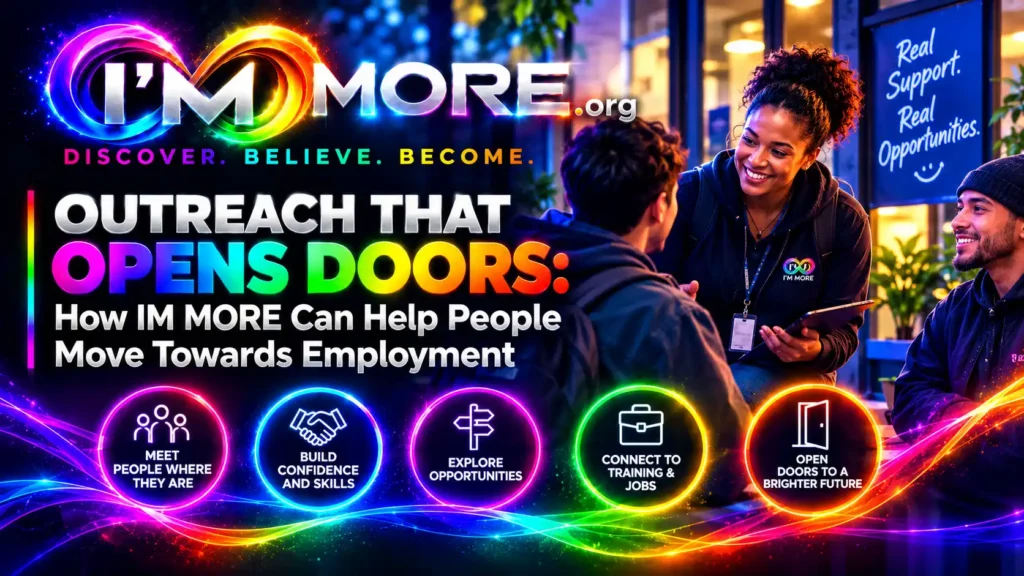
An effective employment outreach strategy helps people overcome barriers to finding work by connecting them with practical support, career guidance and meaningful opportunities. Finding work is not always as simple as sending out applications. People may need confidence, practical skills, reliable information, encouragement, professional connections, or support to understand what employers are looking for. Effective outreach begins by meeting people where they are, listening to what they need, and helping them take realistic steps towards employment.
For IM MORE, outreach can be more than promoting a campaign. It can be a way to build relationships, understand barriers, connect people with opportunities, and evolve the campaign in response to what works. The aim is not to promise jobs that cannot be guaranteed, but to help people become better prepared, better connected, and more confident in pursuing them.
1. Employment Outreach Strategy: Start with People, Not Just Promotion
A strong outreach strategy starts with understanding the people IM MORE wants to reach. Some may be looking for their first job; others may be out of work, changing direction, returning after a break, or unsure what they can offer an employer. Each person’s circumstances are different, so a single message or activity may not work for everyone.
Begin by listening. Ask young people, community organisations, training providers, and employers what challenges they see. Find out what people need most: CV support, interview practice, digital skills, careers advice, confidence, access to vacancies, or help understanding apprenticeships and training.
Practical actions:
- Hold informal conversations at community venues, youth hubs, colleges, libraries, and local events.
- Use short surveys or feedback sessions to identify the main barriers to employment.
- Offer clear ways for people to say what support would help them.
- Make outreach welcoming, accessible, and respectful of different backgrounds and abilities.
2. Build trust before asking people to engage
People are more likely to engage with a campaign when they feel respected and understand what it offers. Outreach should be honest about what IM MORE can provide, what it cannot provide, and what the next step involves. Avoid making employment guarantees or presenting a single route as suitable for everyone.
Use straightforward language, respond to enquiries, protect personal information, and follow through on commitments. If someone is referred to a service or employer, explain what will happen next and ask permission before sharing their details.
3. Turn awareness into practical employment support
Campaign visibility matters, but outreach should give people a clear route from discovering IM MORE to taking a useful action. Each contact should offer a realistic next step, such as attending a workshop, completing a skills checklist, booking a careers conversation, or exploring verified vacancies and training options.
A practical pathway could include:
- Discover: People hear about IM MORE through community partners, social media, events, or word of mouth.
- Connect: They contact the campaign, attend a session, or express interest in support.
- Understand: A short conversation identifies their goals, strengths, needs, and any barriers.
- Prepare: They access relevant help with CVs, applications, interviews, digital skills, or job-search planning.
- Connect to opportunity: Where appropriate, they are signposted or referred—with consent—to employers, apprenticeships, training, or specialist services.
- Follow up: IM MORE checks whether the next step was useful and what additional support may be needed.
4. Create partnerships that lead to real opportunities
No outreach campaign can solve every employment barrier alone. Partnerships can help connect people to opportunities and specialist support. Potential partners include local employers, colleges, apprenticeship providers, job and careers services, community groups, charities, libraries, and organisations supporting people who face additional barriers.
The most useful partnerships are specific. Rather than simply asking an employer to support the campaign, ask what would make collaboration practical: workplace visits, career talks, mock interviews, CV feedback, work experience where appropriate, information about entry-level roles, or clear routes to apply for current vacancies.
Partnership principles:
- Agree what each partner can realistically offer.
- Make referral routes and points of contact clear.
- Share personal information only with appropriate permission and safeguards.
- Review whether referrals result in useful conversations, training, interviews, or other progress.
5. Help people recognise and communicate their strengths
People may underestimate the skills they already have. Caring responsibilities, volunteering, education, hobbies, community activities, and personal projects can all help someone identify transferable skills, although they do not replace role-specific requirements.
IM MORE can help participants identify examples of communication, reliability, teamwork, problem-solving, creativity, organisation, and learning. The next step is to help them explain those skills clearly in a CV, application, portfolio, or interview.
For example, someone who helped organise a community event may have experience coordinating tasks, communicating with others, and responding to unexpected problems. With reflection and accurate wording, they can explain what they actually did and what they learned.
6. Use digital outreach without losing the human connection
Digital channels can help IM MORE reach people who may not attend an event or know where to look for support. Short videos, social posts, articles, email updates, and partner newsletters can explain opportunities and share practical advice. Content should be accessible, easy to understand, and clear about the action a reader can take.
Content ideas include:
- Short tips on CVs, applications, interviews, and workplace confidence.
- Explainers about apprenticeships, training routes, and entry-level roles.
- Participant stories shared only with informed permission and presented accurately.
- Employer Q&As about skills and recruitment processes.
- Event announcements with clear dates, locations, eligibility, and contact details.
- Links to verified vacancies and trusted careers or training resources.
Digital communication should support, not replace, personal contact. Offer offline options where possible and avoid assuming everyone has reliable internet access, a suitable device, or confidence using online services.
7. Evolve the campaign by listening, testing, and learning
An outreach campaign should not stay fixed simply because its original plan looked good. The needs of the community, local labour market, and partner organisations can change. IM MORE can evolve by reviewing evidence, asking for feedback, and making small improvements over time.
A simple improvement cycle:
- Listen: Gather feedback from participants, partners, and employers.
- Identify: Choose one specific issue to improve, such as low event attendance or confusion about how to access support.
- Test: Try a small change—for example, a different event time, clearer sign-up instructions, or a new community partner.
- Measure: Review whether the change improved engagement or helped people take the next step.
- Adapt: Keep what works, revise what does not, and share learning with the team.
Evolving the campaign also means evolving ourselves. The team should be willing to learn new outreach methods, improve communication, challenge assumptions, build stronger partnerships, and recognise when a different approach is needed.
8. Measure progress—not just attention
Reach and social media engagement can show whether people are noticing a campaign, but they do not tell the whole story. IM MORE should also look at whether outreach helps people take meaningful steps towards employment or training.
Possible measures include:
- Number of people reached and enquiries received.
- Attendance at sessions and completion of agreed next steps.
- CVs, applications, interview practice, or skills-development activities completed.
- Referrals made and whether participants successfully connected with the receiving service.
- Interviews, work experience, training starts, apprenticeships, or job starts reported by participants.
- Participant feedback on confidence, usefulness, accessibility, and respect.
- Employer and partner feedback on the quality and usefulness of collaboration.
Use clear definitions, protect personal data, and be transparent about what is being measured. Employment outcomes are influenced by many factors, so avoid claiming that the campaign caused an outcome unless the evidence supports that conclusion. Track outcomes over an appropriate period and use the findings to improve the support offered.
9. Make the next step clear and achievable
People can lose momentum when advice feels overwhelming. Outreach works better when the next action is specific, manageable, and relevant to the person’s situation. Instead of simply telling someone to improve their employability, help them choose one step they can take this week.
For example:
- Update one section of a CV.
- Identify three roles or training options that match their interests.
- Practise answering one interview question.
- Register for a verified careers or training event.
- Contact an employer or support service using a prepared message.
A practical 30-day outreach plan for IM MORE
Week 1 — Listen and map needs. Speak with potential participants and local partners. Identify the priority audience, the main barriers, and the support already available.
Week 2 — Build the pathway. Choose one or two realistic activities, confirm partner roles, prepare clear communications, and make the sign-up or referral process simple.
Week 3 — Deliver a small pilot. Run a focused outreach activity, such as a CV workshop, employer Q&A, community drop-in, or signposting session.
Week 4 — Review and improve. Collect feedback, review participation and next steps, identify gaps, and agree what to repeat or change in the next cycle.
Outreach is a relationship, not a one-off campaign
Helping people move towards employment takes more than sharing a message or organising an event. It requires listening, trust, practical guidance, relevant partnerships, and follow-through. It also requires the campaign to learn from the people it aims to serve.
For IM MORE, the opportunity is to create a clear and supportive bridge between people, skills, and opportunities. Start with what the community needs, help each person identify a realistic next step, build partnerships that offer genuine value, and measure progress honestly. Then use what you learn to improve the campaign.
The aim is not simply to reach more people. It is to help more people move forward—with greater confidence, stronger connections, and a clearer understanding of their next opportunity.
IM MORE — Discover. Believe. Become.
Unlocking Potential, Changing Futures.