

Introduction
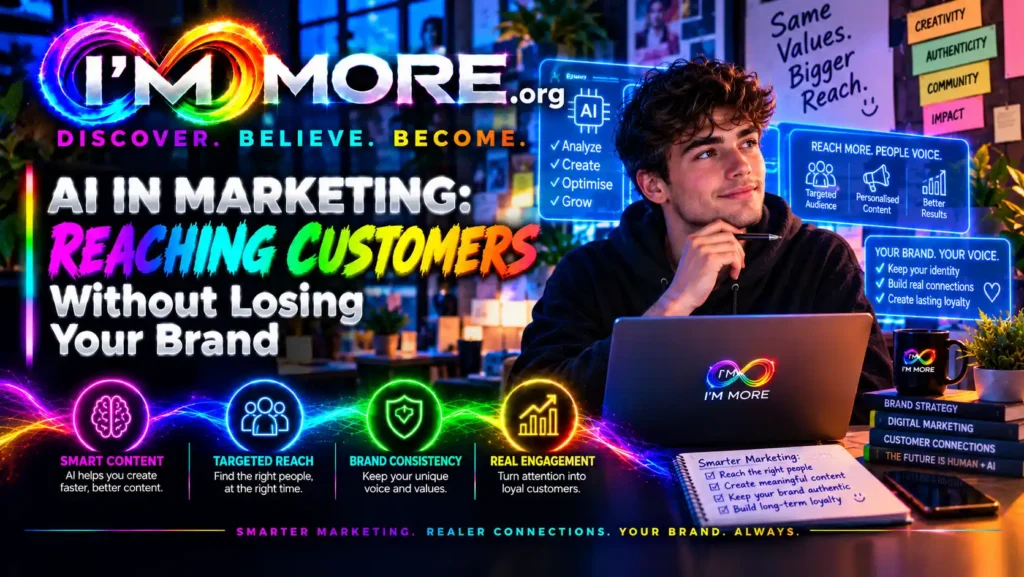
Marketing has always been about understanding people, earning attention and building trust. Artificial intelligence (AI) can help businesses work faster by supporting research, drafting content, analysing campaign results and generating creative ideas. But speed is not the same as connection. If every post sounds the same or every message feels automated, a brand can lose the personality that made people care in the first place.
The opportunity is to use AI as a tool for better marketing—not as a replacement for human judgement, creativity or relationships.
1. Use AI to support your voice, not replace it
AI can help brainstorm campaign themes, suggest headlines, adapt a message for different platforms or turn a long article into shorter social posts. It is most useful when you give it a clear brief: who you are speaking to, what you want people to understand, and how your brand should sound.
For example, a community-focused organisation might ask AI to draft three versions of an event announcement: friendly, energetic and informative. A person who understands the organisation should then choose the strongest version and make sure it sounds genuine. Keep a simple brand voice guide with your preferred words, tone, values and phrases to avoid. Treat AI’s first draft as raw material—not the finished product.
2. Understand customers without treating them like data points
AI tools can help organise feedback, identify recurring questions and spot patterns in campaign performance. Used carefully, these insights can help a business answer real customer needs instead of guessing what might work.
However, personal information must be handled responsibly. Before uploading customer details into an AI tool, check what the tool does with that information and whether you have a lawful reason to use it. The UK Information Commissioner’s Office explains key considerations in its guidance on AI and data protection. A useful rule is to share the minimum information needed, remove identifying details where possible, and follow your organisation’s privacy and security procedures.
3. Personalisation should feel helpful—not intrusive
AI can help tailor messages to different audiences, such as recommending relevant products, adapting email content or grouping common interests. Done well, personalisation makes information easier to find and helps customers receive messages that matter to them.
Done badly, it can feel invasive or manipulative. Avoid using sensitive assumptions or targeting people in ways they would find surprising. Make sure marketing preferences and permissions are respected, and review the UK ICO’s direct marketing guidance when planning campaigns that use personal data or electronic messages. The goal is relevance, not making customers feel watched.
4. Keep your claims honest and your content accurate
AI can produce confident-sounding copy that contains errors, exaggerated promises or details that do not apply to your product. Always check facts, prices, dates, product features, testimonials and any claims about results before publishing. If you cannot prove an objective claim, do not present it as fact.
The Advertising Standards Authority’s guidance on misleading advertising explains why adverts must not mislead consumers and why objective claims need supporting evidence. This applies whether a sentence was written by a person, generated by AI or edited by both. Human review protects customers and your reputation.
5. Use AI-generated visuals and content thoughtfully
AI can speed up the creation of campaign concepts, background images and visual variations. But generated content can include inaccurate details, odd representations or imagery that does not reflect the real product or service. Review every asset carefully, check permissions and platform rules, and do not let a polished image promise something customers will not actually receive.
Google’s guidance on generated images in Google Ads notes that AI-created assets still need advertiser review and may be subject to disclosure or labelling requirements in some circumstances. Check the rules that apply to your market and campaign, and be transparent when disclosure is required or when it would help customers make an informed decision.
6. Measure what matters—and learn from people
AI can help summarise performance data, compare campaign variations and suggest questions to investigate. But a high click-through rate does not automatically mean a campaign has built trust, and a large number of impressions does not prove that a message was meaningful.
Combine the numbers with human feedback: Are customers asking better questions? Do they understand the offer? Are people returning? What complaints or misunderstandings are appearing? Use AI to help interpret patterns, then verify the conclusions and decide what to change. Marketing works best when data informs judgement rather than replacing it.
7. A practical checklist before publishing
Before any AI-assisted campaign goes live, ask:
- Does this sound like our brand and reflect our values?
• Have we checked every factual claim, price, date and promise?
• Have we protected personal or confidential information?
• Is the message relevant without being intrusive?
• Do the images accurately represent what customers can expect?
• Have we followed the relevant advertising, privacy and platform rules?
• Has a person with the right context approved the final version?
Conclusion: Let technology make the work stronger
AI can help marketers explore ideas, work more efficiently and understand campaign performance. It cannot take responsibility for your promises, understand every human nuance or build a genuine relationship on your behalf. Those things still depend on people.
The strongest approach is simple: let AI help with the workload, let evidence guide your decisions, and let your people protect the voice and values behind the brand. Reaching more customers matters—but earning their trust is what makes them stay.
You’ve been reading a story created as part of The Voice by I’M MORE, where young people aged 18–24 are encouraged to share ideas, experiences and perspectives while developing confidence, courage, direction, new skills and personal growth. Explore more stories from The Voice here, discover more about the work and mission of I’M MORE here, take a look at my story here https://immore.org/category/tech-wiz as I talk all about AI. Every voice matters, every experience can teach us something, and every person has more potential within them than they may yet realise.
IM MORE — Discover. Believe. Become. Unlocking Potential, Changing Futures.













