Introduction
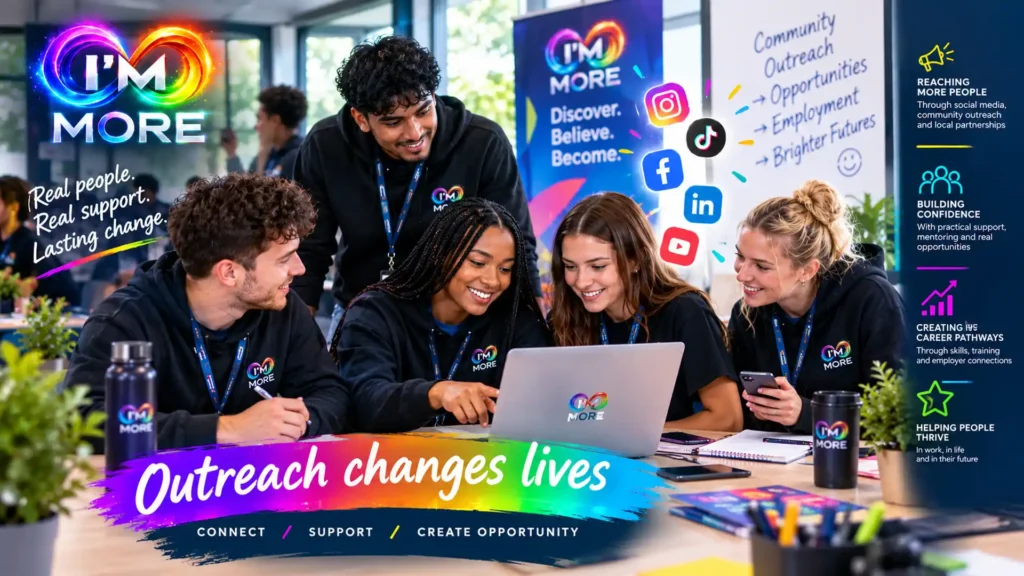
The challenge is not always a lack of ambition or ability. Sometimes people need access to opportunities, practical experience, guidance or the confidence to take their next step. Outreach strategies to tackle unemployment create opportunities to connect with people who might otherwise struggle to access employment support, helping them identify strengths, develop skills and establish relationships with employers. Effective outreach strategies to tackle unemployment help bridge the gap between job seekers, training providers and employers, creating practical pathways towards meaningful employment.
At I’M MORE, the principle of Discover. Believe. Become. offers a useful starting point. It recognises that people can develop their potential through personal growth, practical learning and access to meaningful opportunities. The Discover. Believe. Become. programme reflects this approach by connecting confidence-building with practical development. The wider objective is to build a pathway that moves people from uncertainty towards employment, education, training or enterprise. That requires individuals, employers, communities and support organisations to work together.
1. Understanding Unemployment and the Need for Outreach
Official labour market statistics help explain the scale of the challenge, but they cannot describe every individual’s experience. The Office for National Statistics (ONS) publishes UK unemployment data that can help organisations understand labour market conditions. However, a person may need help with a CV, while a community may need stronger links between employers and training providers. A local area may need to address transport barriers or a shortage of accessible training. The strategy must therefore connect individual support with wider changes in opportunity. Developing outreach strategies to tackle unemployment requires understanding the different challenges individuals face when searching for suitable employment opportunities.
3. The I’M MORE Approach: Discover, Believe, Become
Believe: Building Confidence Through Practical Experience
Outreach programmes can create opportunities to practise communication, receive constructive feedback and complete achievable tasks. A participant might begin by introducing themselves to a small group, then progress to delivering a short presentation or speaking with an employer. Each experience provides evidence of what they can do and where they can improve.
I’M MORE’s The Stage provides an example of creating opportunities for people to share their stories, develop confidence and become more comfortable expressing themselves.
4. Connecting Job Seekers with Employers
Outreach becomes particularly valuable when it connects individuals directly with employers. For many job seekers, the greatest difficulty is getting the opportunity to demonstrate their abilities. A CV may contain limited employment history, especially for a school leaver or someone returning to work after a long absence. Employers reviewing numerous applications may overlook candidates who have considerable potential. Initiatives such as I’M MORE’s Be Seen aim to help connect individuals with greater visibility and employment opportunities. Employer partnerships are an important part of outreach strategies to tackle unemployment, helping job seekers gain practical experience and demonstrate their potential.
6. Evolving Your Personal Journey Towards Employment
Build a Portfolio of Evidence
A portfolio is a practical way to demonstrate ability, especially when employment history is limited. It might include a project completed during training, a presentation, a design, evidence of volunteering or feedback from a mentor. Its purpose is to help employers see what someone can do. Candidates should explain their contribution honestly and distinguish their own work from anything completed by a team. For guidance on preparing an application, the National Careers Service CV advice explains how to present skills, experience and achievements clearly.
Learn from Setbacks
Rejection is a common part of job searching. An unsuccessful application does not necessarily mean someone lacks potential. It may reflect competition, timing, a mismatch between the role and the candidate’s experience or a weakness in how the application was presented.
Whenever possible, review the experience. Was the CV tailored to the vacancy? Did the application provide examples of relevant skills? Were interview answers clear and specific? Would further training improve the candidate’s prospects? The National Careers Service STAR interview method can help candidates structure examples of their skills and experience for interviews and applications.
Not every employer will provide feedback, so individuals should avoid interpreting rejection as a definitive judgement about their worth. Progress comes from learning what can be improved and continuing to seek appropriate opportunities. People returning to employment after a career break can also explore I’M MORE’s career change and employment support for additional guidance.
7. Finding Training and Employment Opportunities
Personal development should connect with realistic routes into work. Individuals can explore current vacancies through the official GOV.UK Find a Job service, which allows people to search for full-time and part-time opportunities in England, Scotland and Wales.
For people interested in earning while learning, GOV.UK apprenticeship information explains how to search and apply for apprenticeships in England. Apprenticeships combine employment with training and can provide a route into occupations that require practical experience and recognised qualifications.
Adults looking to retrain or develop sector-specific skills can also investigate Skills Bootcamps through Skills England. Individuals should check current course availability, funding arrangements and entry requirements before committing to a programme.
For I’M MORE participants and other people seeking local guidance, the employment and training resources for Essex provide a relevant starting point for exploring support, developing employability skills and identifying potential training opportunities.
Conclusion: Creating a Future Beyond Unemployment
For anyone currently looking for work, the journey towards success does not have to begin with a perfect CV, extensive experience or complete certainty about the future. It can begin with a conversation, a new skill, a small project, a training opportunity or the decision to seek help. Every meaningful step creates the possibility of another. By combining community engagement, skills development and employer partnerships, outreach strategies to tackle unemployment can create more accessible pathways towards long-term career success.
Unemployment may describe someone’s present circumstances, but it does not have to define their future. Through effective outreach, continuous learning and opportunities to demonstrate their abilities, individuals can develop the confidence, skills and professional relationships needed to build a more secure and rewarding working life.
The wider ambition should be to create a labour market in which potential is recognised, opportunity is accessible and success is measured not only by getting people into work, but by helping them build careers in which they can continue to learn, contribute and thrive.
Discover your potential. Believe in your ability to grow. Become the person who can take the next opportunity forward.
Take the Next Step with I’M MORE
Explore I’M MORE to learn about its approach to personal development, confidence building and employment opportunities.